
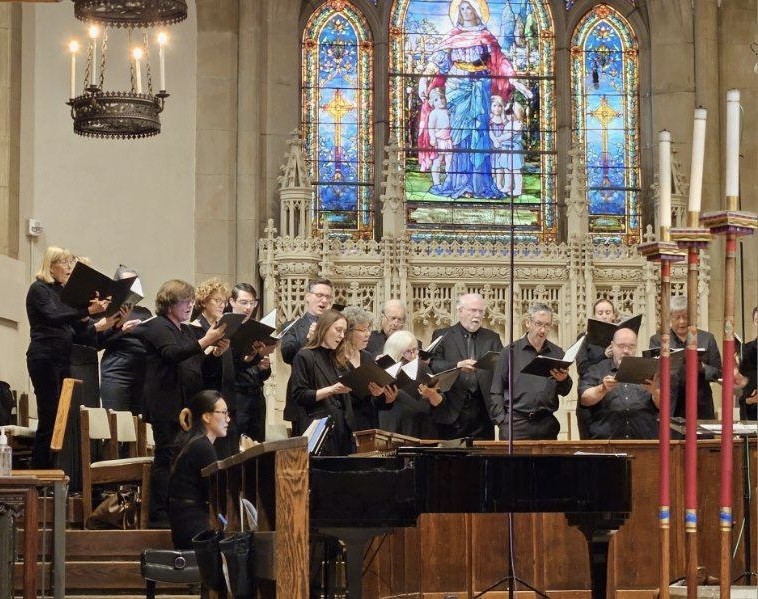
At All Saints Church in Pasadena, choir sings during Jan. 11 diocesan Climate Evensong marking one-year anniversary of Eaton and Palisades wildfires. Dr. Lucy Jones, seismologist and Evensong organizer, is pictured at left, first row, just above pianist Haesung Park of St. Matthew’s, Pacific Palisades. Photo: Kathy Eisel
Some 250 voices from around the Los Angeles diocese joined the poignant strains of violin, cello and organ, Sunday, Jan. 11 at All Saints Church in Pasadena, in the ancient Anglican prayer practice of Evensong, singing of sorrow, faith, resilience, renewed commitment and remembrance, one year after “once-in-a-century” wildfires destroyed area lives, homes, schools and churches. Evensong video is here.
Bishop John Harvey Taylor welcomed those attending the diocesan Climate Evensong, created by seismologist Dr. Lucy Jones, senior warden at St. James, South Pasadena. Officiating was the Rev. Carri Patterson Grindon, rector of St. Mark’s Church in Altadena, which was destroyed in the Eaton fire.
Patterson Grindon was joined by Cantor-Emeritus Mark Saltzman of Congregation Kol Ami, West Hollywood, in singing portions of the service, for which Jason Klein-Mendoza of St. James, South Pasadena, conducted the choir including singers from various congregations affected by the fires, and Dr. Haesung Park of St. Matthew’s, Pacific Palisades, was organist. A report of Jan. 7 memorial concerts and liturgies at St. Matthew’s, with members of the L.A. Master Chorale, is here.
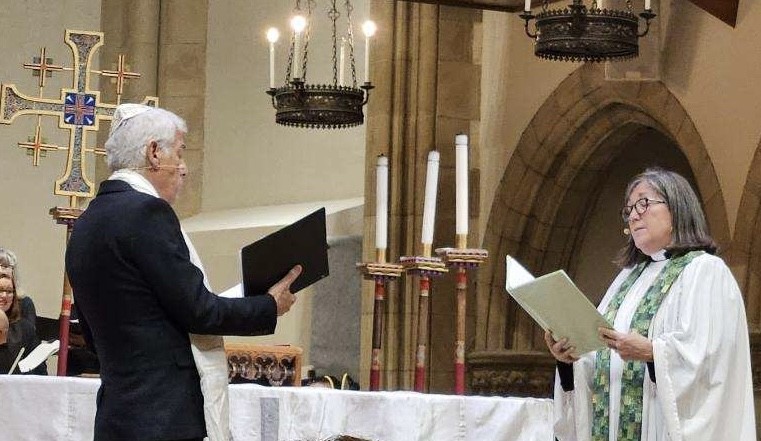
Cantor Mark Saltzman joins officiant, the Rev. Carri Paterson Grindon — rector of St. Mark’s, Altadena — in singing during liturgy.
The season of Epiphany commemorates new awarenesses, and recalls the story of the magi, “three visitors from the East who have made the most grueling journey of their lives” and begets new understandings, empathy and ultimately, self-giving love, said Taylor. He had spent much of the week among victims of the fires that devastated much of the Pacific Palisades, Altadena and Pasadena areas.
“Tonight, we gather in the quiet beauty of this ancient form of prayer to share our grief and anger at what we have lost, to honor the pain that still lives in our bodies, our memories, and our landscapes,” said Jones, in a statement included in the evening’s program.
“Some of us have lost homes, churches, treasured places, or people we love; all of us come carrying the weight of living in a world where disasters like these are no longer rare. We are creating space for grief that has no easy answers, and for questions that have no simple solutions.”
The prelude that opened the Evensong was Jones’s own composition In Nomine Terra Calens, in which the cello plays a cantus firmus representing global climate data. “Each year from 1880 to 2017 is represented by a whole note whose pitch corresponds to the average global temperature that year, with a higher pitch being warmer temperatures,” program notes stated.
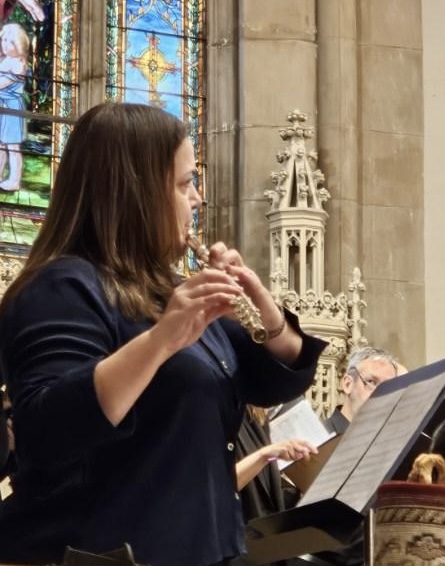
The Rev. Michelle Baker-Wright plays flute as congregation sings the Lord’s Prayer in a musical setting she composed.
On Jan. 7, 2025, wildfires erupted in L.A., killing hundreds, forcing thousands to evacuate and destroying more than 16,000 structures. In Pacific Palisades, St. Matthew’s Church withstood the blaze but several campus buildings were destroyed. Clergy and members of the congregation lost their homes. The congregation resumed worship in the church in the fall of 2025. Preschool through 8th grade students, now meeting in West L.A. and Santa Monica, are expected to return to the campus in the fall of 2026.
St. Mark’s Church now meets at St. Barnabas, Eagle Rock, and students of the preschool through 6th grade, are temporarily meeting at an alternate site, “St. Mark’s Village” in Pasadena.
Parishioners and vestry members of St. Barnabas, Pasadena, also lost homes, as did members of Church of Our Saviour, San Gabriel, which sponsored a sober-living house that was destroyed as well.
“No one in history knows more than you do about surviving catastrophic, once-in-a-century wildfire. That experience, that knowledge, that understanding, makes you teachers, makes you empaths, makes you pastors, makes you prophets,” Taylor told the gathering.
The service was offered jointly by the diocesan Commission on Liturgy and Music, and the Bishop’s Commission on Climate Change. Created in 2022 with the Rev. Canon Melissa McCarthy as founding chair, the climate change commission aims to bring attention to the spiritual foundations of creation care and to engage the intersections of food insecurity and racial justice, tracking of federal, state, regional and local legislation and to develop resources for diocesan congregations, schools, institutions and individuals to address climate change.
The fires are part of a larger story, of climate change “in a warming world, where longer fire seasons, hotter temperatures, and deeper droughts make extreme events more likely,” Jones wrote in a statement. “To pray with integrity in the face of climate change is to allow our lament to move us toward action to listen for how we are being called to protect one another, to safeguard creation, and to change the systems and habits that are driving this crisis.”
Commenting after the service, Jones reiterated that “We’re not moved to action unless we’re emotionally engaged.”
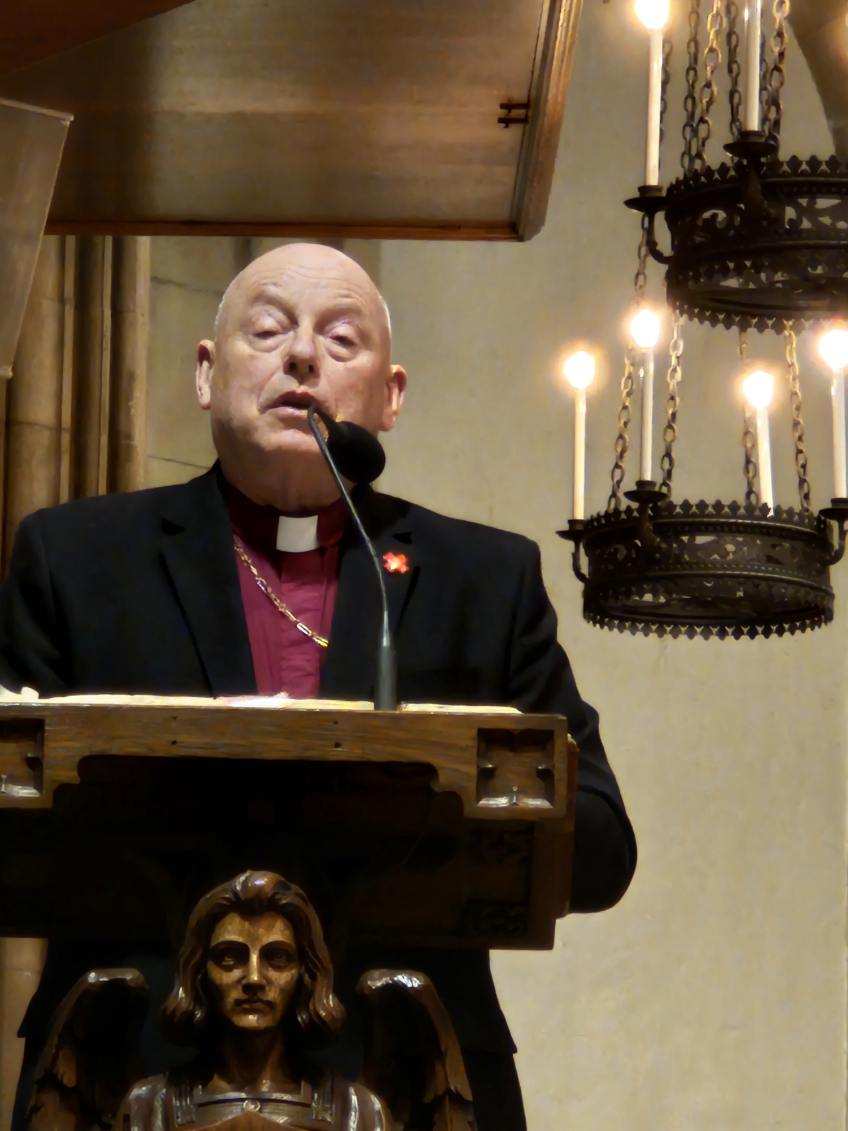
Bishop John Harvey Taylor gives opening remarks at Climate Evensong.
Taylor expressed gratitude for Evensong organizers, those attending and those whose experience has brought them a step closer to the realities of those impacted by climate change, whom the current administration often targets.
“Our government chooses scapegoats whose personal experiences most Americans don’t know or understand,” Taylor said. “It’s chosen our Trans and nonbinary siblings, it’s chosen immigrant workers, some who have been here for 30 years or more, raising their families, paying their taxes, sending their kids to school, sending kids to serve in the United States Marines, but who are here without representation.
“They are here without voice in our politics, so we don’t fully understand their experience. We think tonight, of the largely unseen people injured the most by climate change, people who live and labor in the global South or in low-income communities,” he said. “We think of those laboring under the hot sun outside while picking our fruits and vegetables in the Central Valley, as people from Central America have been doing for the better part of a century without representation, without being officially noticed.”
But sharing narratives across differences, of those scapegoated and of all the victims of “catastrophic wildfires that burn hotter and burn longer because of climate change, … learning about the experience of those who suffer—there can be no more subversive and liberating and freeing thing that we can do.”
Jones said the evening was about remembering, but also about recognizing the resilience emerging from the ashes, about the way “communities have opened their doors to one another. Congregations have shared sanctuaries, bells have been lifted from the rubble, and crosses darkened by smoke have continued to watch over people at prayer.
“The same flames that destroyed buildings could not extinguish courage, generosity, or love,” she said. “Neighbors have fed one another, housed one another, and held one another’s stories. Tonight, we give thanks for that strength — for every act of kindness, every shared meal, every tear welcomed rather than turned away — and we name it as a sign of the divine that walks with us through the fire and beyond.”
The service was also about commitment, and action, she added. “In the language of this liturgy, we ask not only for comfort, but for courage; courage to advocate for policies that protect the most vulnerable, to transform our own choices, and to stand together for the future of our children and of all life on this earth.”
The Bishop’s Commission on Climate Change hopes to connect directly with many Episcopal congregations and communities in the diocese, to offer resources and to mobilize effective action. For more info, visit: https://diocesela.org/commission-on-climate-change/community-liaisons/.
.