[The Episcopal News] – Living “through a moment of deliberate, organized cruelty aimed at some of the most vulnerable people in our society,” means there is an urgent need and there are dozens of ways for faith communities to join the Sacred Resistance movement, the Rev. Canon Jaime Edwards-Acton told a March 21 gathering at St. George’s Episcopal Church in Laguna Hills.
In Orange County, just like Los Angeles, just like in Minnesota and Chicago and in many other communities, “Parents are being taken from their children at school, … folks who have been our neighbors and fellow church members for decades, who have worked here, raised their children here, who sit beside us in the pews, these folks are living in fear. It is real and it is urgent,” said Edwards-Acton, co-chair of the diocesan Sacred Resistance Task Force.
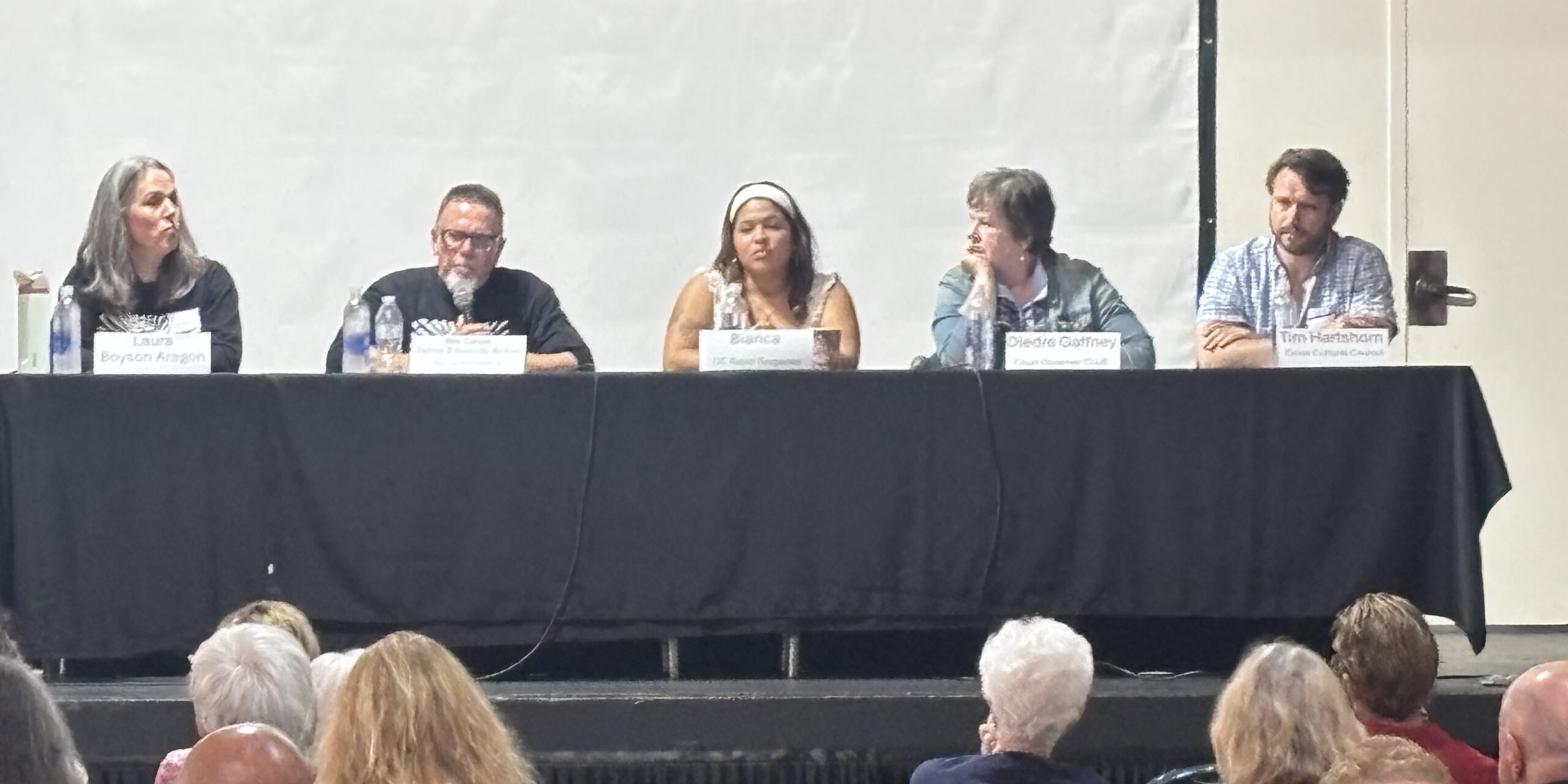
From left: Laura Boysen Aragon, moderator; Rev. Canon Jaime Edwards-Acton; Bianca, organizer with the Orange County Rapid Response Network; Deidre Gaffney of Clergy and Laity United for Economic Justice (CLUE), also an immigration court observer; and Tim Hartshorn, executive director of the Laguna Cross-Cultural Council.
“It isn’t only immigrants who are under threat,” he added. “We are watching coordinated attacks on other marginalized and vulnerable groups, as well as Transgender folk. Our reproductive rights are being threatened. Our voting rights are being eroded. The democratic norms that hold up this society, they’re being dismantled, piece by piece. We’re all feeling it, and the first act of faithful resistance is simply telling the truth about what is happening.”
Edwards-Acton joined a panel of community activists, including Deidre Gaffney, of Clergy and Laity United for Economic Justice (CLUE) and an immigration court observer; “Bianca”, an Orange County Rapid Response Network organizer and Tim Hartshorn, executive director of the Laguna Cross-Cultural Council.
The panel was moderated by Laura Boysen Aragon, development director at the Loyola Institute for Spirituality (https://www.loyolainstitute.org/) in Orange, who is in discernment for priesthood in The Episcopal Church. The event was designed as a first step “to develop a broad coalition of people and organizations committed to justice, care for the most vulnerable, and a robust infrastructure to address real-time issues, despite our increasingly volatile political environment,” according to the Ven. Laura Siriani, diocesan archdeacon who serves at St. George’s, and who organized the event.
“I have had a little war with myself, between despair and hope,” Siriani told those attending. “And hope has won out because of you. We know we can do this together.” Participants left “knowing there is a role for everyone. We hope this is the beginning of a significant Sacred Resistance presence in Orange County.”
Siriani invited guests to visit information booths for info about each of the panelists’ organizations, along with the Concerned Citizens of Laguna Woods; ICE Out and the St. George’s Daughters of the King, who offered a collection of resistance prayers. Additionally, guests were invited to visit and purchase their lunch meal from St. George’s weekend Open Air Market, the only source of income for many of the vendors.
Diocesan Sacred Resistance
Sacred Resistance is “not a liberal idea. This is not a conservative idea. It is older than any political party. It is old, at least as old as Moses demanding Pharoah to ‘let my people go’,” said Edwards-Acton. “It is as old as the prophet Micah calling Israel to do justice, to love kindness and to walk humbly. It is as old as Jesus telling his disciples that whenever they serve the hungry, whenever they serve the thirsty or the stranger or those in prison they were serving Him.”
Resistance is included in the baptismal covenant, in the promise to persevere in resisting evil, he added. Those being targeted “need our buildings. They need our networks. They need our moral credibility. They need our willingness to show up. They need to know that they are not alone” as well as the church’s capacity to mobilize and sustain action across time. “And that is exactly what this moment demands.”
Sacred Resistance was created when delegates to the 121st annual meeting of Diocesan Convention in December 2016 overwhelmingly adopted sanctuary status (https://diocesela.org/the-bishops-blog/being-a-sanctuary-diocese/), pledging to resist mistreatment of and to stand with immigrants, refugees, and all people targeted by hate and injustice, Edwards-Acton said.
Subsequently, thousands of clergy and lay persons have been trained to bear witness during ICE raids, serve as rapid responders, and in nonviolent direct action. Volunteers have accompanied community members to ICE check-ins and to immigration court hearings and visited those in detention centers.
“We’ve organized caravans to the border. We’ve built coalitions with legal service providers, with labor unions, with community organizations and interfaith allies across the diocese,” he added. “We’ve developed toolkits and training videos and online resources and music collectives and rapid response networks and folk schools. We’ve showed up in the street when the moment called for it. We call this work faithful resistance. We call it sacredaccompaniment. We call it justice in action.”
Rapid Response: ways to get involved
“Bianca” (her real name changed to protect her identity), said the Orange County Rapid Response Network involves grassroots organizing efforts, community members, lawyers, law school clinics, and impacted family members, purposely empowering those affected and their families in the process.
The group offers community educational and legal resources, food and aid distributions. The network also has established hubs or a presence at locations frequently targeted by ICE, such as Home Depot parking lots and car washes, she said.
Joining Rapid Response “has saved my life tremendously,” said Bianca, 24, who grew up in Orange County. “I’ve lost count of how many times I’ve been stopped just by the police and now also by border patrol. Doing this work, makes me feel like I’m not crazy, like I’m not the only one who’s seeing what’s going on, or feels the anxiety, (of) what’s happening.” The network seeks volunteers in a variety of roles and may be reached by phone at 714-881-1558.
Laguna Cross-Cultural Council
Although the Laguna Cross-Cultural Council in Laguna Beach was forced to close because of the ICE raids, its mission continues, with weekly grocery deliveries, rental support, and online hiring of day workers through the website, said executive director Tim Hartshorn.
“We’ve raised and distributed over $45,000 in rental support. People are struggling to make rent, especially undocumented folks who often pay their rent through sort of circuitous, heavily mediated means, public intermediaries.”
Additionally, a Family Companion Program will launch soon, with resources focused on children, and access to quality health care, and assistance with legal and bureaucratic matters, media literacy and providing transportation, he said. The agency seeks volunteer drivers for food deliveries and for those with experience in community health networks.
‘Public witness earns the church the right to speak’
Public witness becomes real when members step outside their churches, “when we carry the values we profess and our liturgy into the public spaces where power is actually exercised,” Edwards-Acton told the gathering.
At a time, “when some of our most vulnerable neighbors are being told by the actions of this government, that they do not belong, that they are not seen, that their dignity is negotiable, the physical presence of people of faith in the public square is a counter proclamation to all that. It declares you are seen, your dignity and worth are nonnegotiable, and the community of faith will stand by your side.”
Public witness also transforms the witness, he added. “We often speak of public witness as something we do for others, and it is that. But anyone who has stood outside immigration court in the early morning or marched down downtown streets alongside families who are terrified or sat with someone in detention waiting room or in a courtroom, that person knows that transformation is mutual. You can’t show up for someone in their most vulnerable moment and remain unchanged.”
Sacred Resistance, in addition to skill building, education, and spiritual formation, creates an historical record, of those “who bore witness, who refused to let injustice pass. Public witness is essential, because it’s how the church earns the right to speak.
“There is a credibility that cannot be manufactured through statements, press releases, prayers or resolutions passed at conventions,” he said. “It is earned only through presence, through showing up before the cameras arrive, through being known in the community, not as an institution that issues positions, but as a body of people who can be counted on to appear when it matters.”
Informed communities are empowered, where people know their rights and fear loses its grip, he added. “When congregations have a plan, they can respond instead of panic. When relationships are created and networks exist, information flows and resources reach the people who need them. When faith communities stand publicly with their neighbors, it changes the moral landscape of a community. It says you are not alone, you are seen, you are valued, and we will not be silent.”
Orange County has one of the largest Vietnamese communities in the United States, along with significant Latinos, Koreans, Filipinos, Middle Easterners, Pacific Islanders — immigrant families who’ve been part of the fabric of this county for generations, all of whom deserve to live without fear,” he said.
“And Orange County also has you, people of faith from across traditions who are unwilling to look away,” he added. “You represent something extraordinary, the possibility of a coalition grounded not in agreement on everything, but in a shared conviction that every human being deserves dignity, every human being deserves safety and justice. Because silence is a choice, and in this moment, silence is a form of complicity.
“The faith communities of this county are here with and for each other, too, and most importantly, the God who has always stood on the side of the poor, the stranger and the oppressed, that God is here too.”