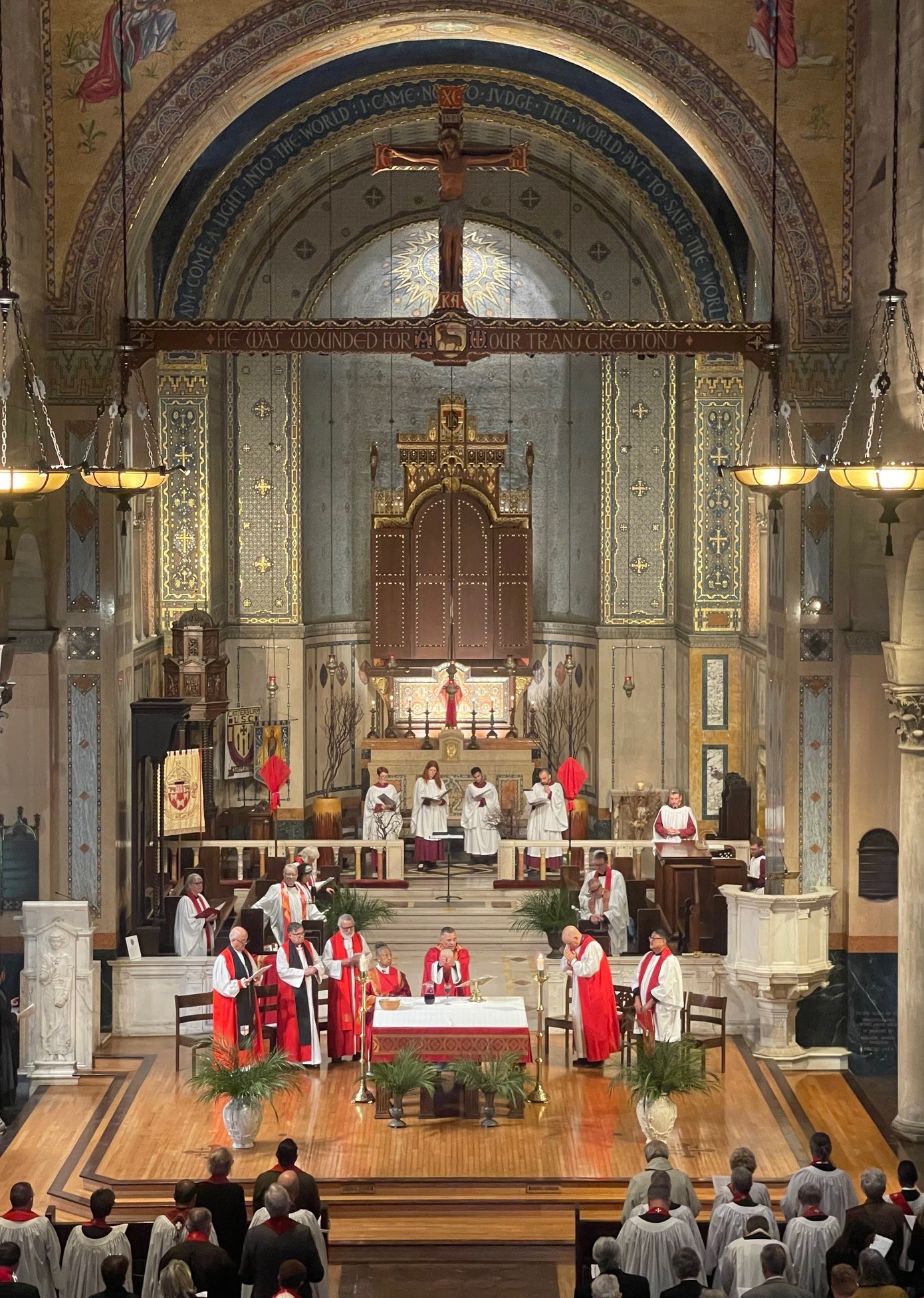
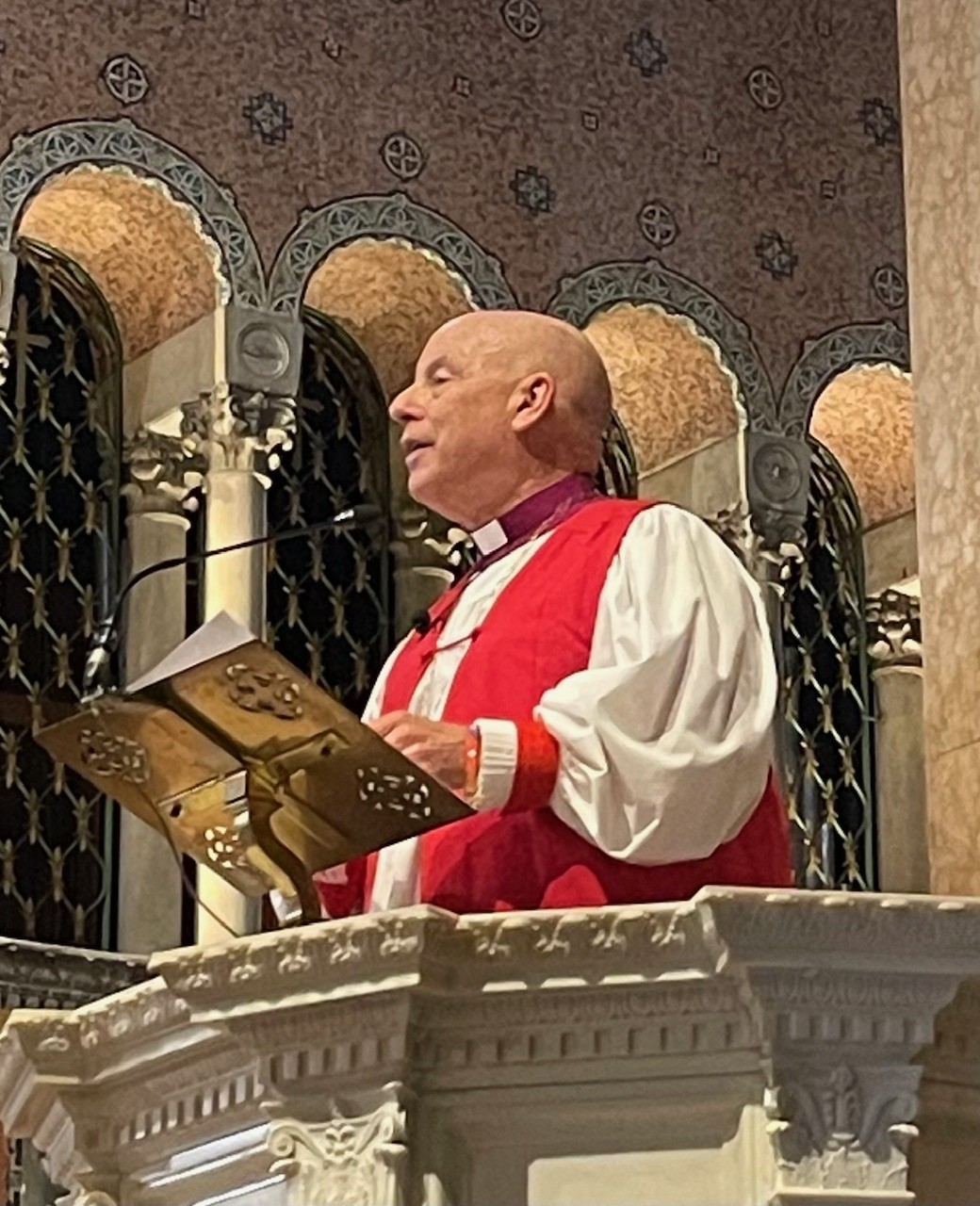
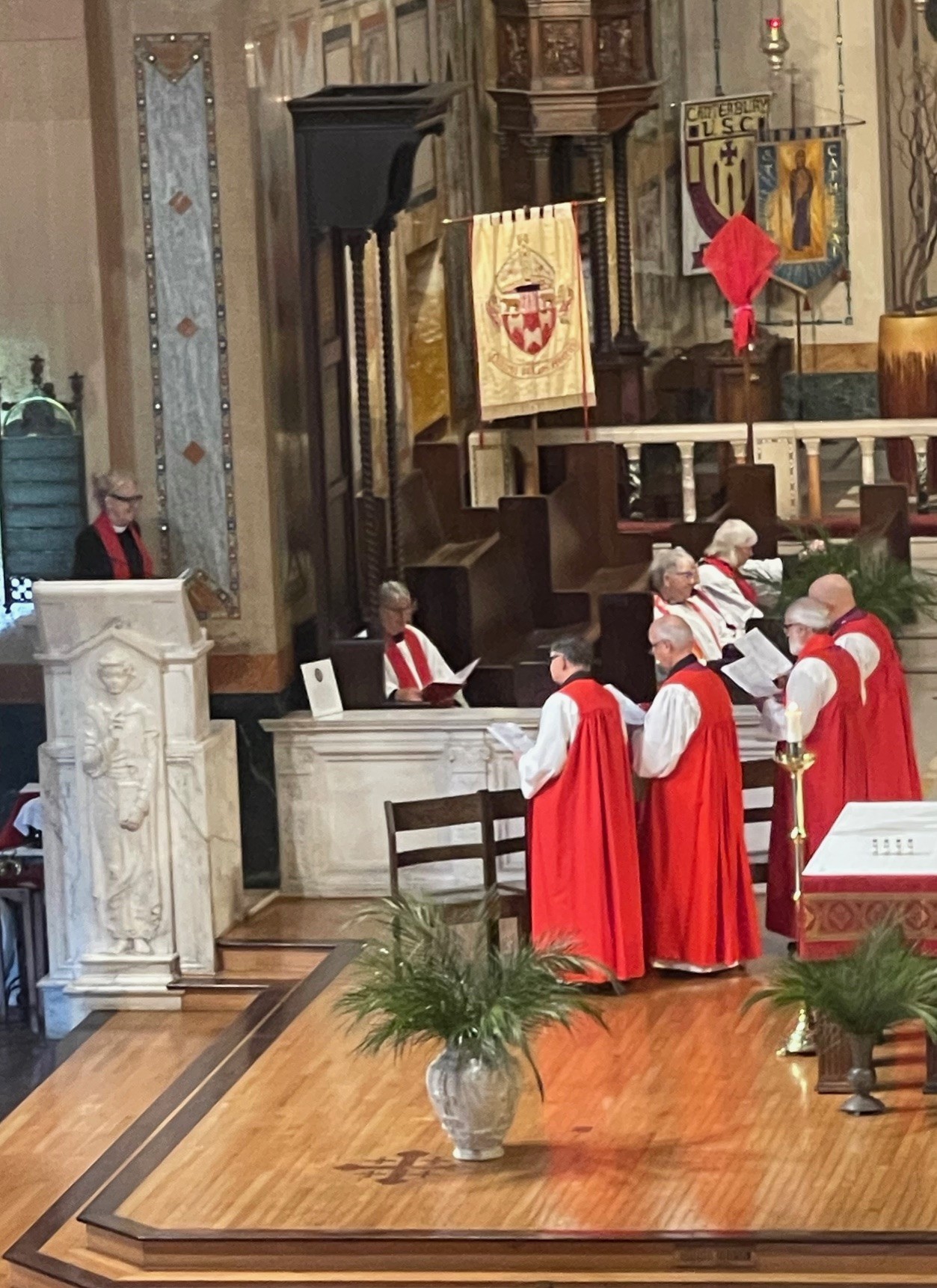
 Preaching at the annual diocesan Chrism Mass and clergy renewal of vows service March 31, Bishop John Harvey Taylor called his colleagues “to work across ecumenical and interfaith lines to crystallize” the golden rule as the “common denominator shared by 160 million people of faith in our country.”
A transcript of Bishop Taylor’s homily – his last at a Chrism Mass before his retirement later this year after nine years as bishop diocesan – follows here.
Colleagues and friends, I greet you on behalf of Bishops Ed, Frank, Nadal, and myself, and we four are here to say collectively, with surpassing joy, that our celebrant for Holy Eucharist this morning is the eighth bishop of Los Angeles, Antonio José Gallardo Lucena. Let’s make him feel welcome!
Earlier this month, Antonio attended his first meeting of the House of Bishops; the House traditionally welcomes bishops-elect as soon as they have received their consents from Standing Committees and bishops. It is believed that it is important to get to know the House’s folkways as soon as possible.
We met at Camp Allen, outside Austin, Texas; Bishop Frank was along as well. I had a vague idea that I would be Antonio’s wingman, introducing him to colleagues. But Antonio has so many friends in the broader church already, and as for bishops he hasn’t met yet, his reputation had preceded him. So the wingman was soon able to fold his wings.
Antonio also adapted quickly to the bishops’ obscure liturgical routines. Our principal sacrament is discussing issue briefly in plenary sessions – breaking into table groups for discussion – and recording our findings on long strips of butcher paper, which we pin to the wall to compare and contrast.
This year, our theme was theological education. Representatives from all the seminaries were there. Our discussion questions were how dioceses and seminaries could work together better to form the deacons and priests the church will need as we prepare for the second third of the secularizing 21st century.
We didn’t talk as much as we might have about diaconal formation; much of what we said about priests applies to deacons, but the sacred order of deacons deserves its own time of sacramental drenching in the House of Bishops. May that day come soon.
But as we gathered at our tables and unfurled our butcher paper and wielded our felt-tip pens and Post-it notes – as we discussed the indispensable qualities of the priesthood in our particular time in the church and in this hungry, wounded culture, all those qualities expressed in one way or another in the vows we renew this morning. I’ll long remember an epiphany I had one morning at Camp Allen. It came to me in a blinding flash; I didn’t write it on butcher paper, but I should have. And here it is: “We aren’t paying you near enough.”
As our lists of the gifts priests need and have, that you have, proliferated – temperamental gifts, administrative gifts, preaching, teaching, pastoral, and prophetic gifts, especially as we talked about the role that our particular church is playing in the spiritual life of our country, steeped in sacramental mystery, trusting that all things and all moments brim with Resurrection power, as a consequence of God vanquishing death at the empty tomb, fixed at long last on a conception of the dignity of every human being that excludes no person on the basis of race and nation, orientation and identification — this is what we proclaim.
Notwithstanding the prevailing civic religion of dog eat dog, survival of the fittest, cruelty for cruelty’s sake, illegal wars for the sake of our leaders’ personal profit; as we’re dragged to the very gates of hell by a gang of grifters who are littering our sacred spaces with their new pagan temples; as we explicitly invite clergy to throw their bodies into the breach: No, we just aren’t paying you enough!
We wrote on butcher paper that we want our priests to know how to run something already, before they’re ordained. We want priests who uncompromisingly proclaim the deathless values of Christ’s love and justice while at the same time holding their diverse communities together in fellowship and unity.
Priests who are devoted pastors to congregants in crisis even as the rest of us are at risk of becoming strangers to our own baptismal calls as pastors, leaving it to those on salary to make the phone calls and send the texts and pay the visits.
 Priest who gather people in when the spirit of the age casts people to the four winds.
Priests who welcome the stranger instead of abusing them, priests who center the marginalized instead of proclaiming, as the vice president does, that Christ commands us to love the stranger last.
Priests who love and bless when our habit is becoming to hating and judging.
Priests who are curious about everyone when the key to wordly success is to model and encourage incuriosity.
Priests who weave a community’s narratives together to tell the Good News story — when our national obsession is to insist on our personal, individual, idiosyncratic view at the exclusion of the cohesion of congregation, community, even our beloved familie.
Priests who do everything right in the world that seems to be getting everything wrong. The gospel warning that the harvest is plentiful and the laborers are few does not begin to express the utter unconventionality of what it is that we do collectively in contrast with the world completely values.
Deacons and priests who are afflicted in every way, as St. Paul writes, but somehow not crushed – perplexed, but we pray not driven to despair – persecuted, but not forsaken – struck down, but by grace, not destroyed.
Last week I met with a group of colleagues as I do every month to discuss some program that we’re all collectively interested in. We began by checking in. One of the priests in our circle has a secular job helping people deal with our wicked immigration system. Because of the way this priest has been formed, this work is an extension of their priesthood. They want to help people, and they work hour after hour each week doing their best, but the politicians are making it harder and harder; our neighbors are suffering more and more>
Finally the stress and anxiety landed them in the emergency room, afflicted, but not crushed; struck down, but not destroyed; hurled into the breach to save God’s people; punished and forsaken for devoting themselves to the divine law of love – the golden rule.
I did manage to get the golden rule onto the butcher paper at the House of Bishops.
Recent events in our country and world have demonstrated that we need bishops, deacons, and priests who are willing to hold power accountable to at least a minimal understanding of divine law.
We all get that the establishment clause of the First Amendment was designed to protect people from the imposition of a state religion, namely, of course, Anglicanism. It does not protect an indecent government from being judged in the light of decent values God holds dear.
But Jesus didn’t come to assert political power or tear down the Roman empire. He didn’t want Caesar’s palace – he wanted Caesar’s soul.
Jesus came to manifest a way of being in the world that challenges all our power, our empires of ego; our ministries of me, myself, and I; our little temples of prerogative and privilege; even the empires of shame some of us hide deep within, which impede our God-given right to feel God’s love.
Jesus’s teachings were so simple — the plain sincerity of prayer, offered privately, not publicly like a big show; not storing up for ourselves treasures on earth; not worrying too much about what we will eat or drink; not worrying about tomorrow; not judging, lest we be judged.
And then in Matthew chapter 7, verse 12: “In everything, do to others as you would have them do to you; for this is the law and the prophets”; 21 words – shortest sermon ever – Jesus, who was a brilliant Bible scholar; Jesus who confronted the tempter not with his own wisdom but from passages from Torah; Jesus, saying that every dit and twiddle of the Hebrew Bible that he knew, every name and narrative, every slaughter and miracle, it all added up to same thing: If you want to be treated kindly, be kind; if you want to receive love, give love; if you want to be safe, make others feel safe; and if you don’t want to be alone, then find someone else and lay waste to their loneliness.
 This is Jesus articulating the universal law of love. Many of us grew up with the same chart on the wall of our classrooms or Sunday schools: The golden rule, of course, shared by every major faith and human philosophy including Confucianism from half a millennium before our Lord manifested himself on the scene.
If, as Jeremiah prophesied, God wrote the law on our hearts at the beginning of all things, this is surely the law Jeremiah meant. When God pleaded in vain with Cain to do the right thing, surely God was appealing to Cain’s instinctual understanding of the golden rule. When the Word was with God at the creation, when the Word was God’s daily delight, surely the Word was busy writing the golden rule into the DNA of the universe.
So in these momentous days, when people ask what’s most important to me about Jesus, I tell them that John 3:16 is wonderful, but give me Matthew 7:12: The law which the Word wrote across the face of creation, the law that knits the heavens together in perfect balance and mutuality, the law Jesus manifested as he rode in vulnerability into the city that would kill him, the law my Risen Savior beseeches me to follow in matters large and small as I make my own way through the world.
Kindness for kindness’s sake, love for love’s sake – never, never, never committing cruelty or violence for their own sake or to score a debating point or obtain political advantage – Jesus embodies these simple things. In the end, they’re the only things that work.
We couldn’t have gotten here on the freeway this morning without the golden rule. We can’t keep a happy home for two weeks without the golden rule.
And yet we’ve not yet found a vocabulary for insisting that small group of people who wield the power of life and death over millions – we haven’t found the gumption to say that they should begin obeying what we take to be the law of nature itself. Whether it is a caution or a reserve or a thinking it is not our place, we cannot afford these niceties anymore.
So one more box to check, I’m sorry to say, for all our lay and ordained leaders – to work across ecumenical and interfaith lines to crystallize the common denominator shared by 160 million people of faith in our country. It’s time to hold power accountable when it violates the golden rule. It’s time to say no in the name of God to cruelty for cruelty’s sake and violence for violence’s sake.
Followers of God must organize ourselves in such a way as to punish golden-rule offenders ruthlessly at the polls and send them home to learn some manners.
For now, I offer thanks first of all to my friend and colleague of over 20 years, the finest canon to the ordinary in the land, the wisest and most loving and insightful counselor imaginable, Melissa McCarthy.
To all our colleagues, thank you for your graciousness and kindness over the years – your warm welcomes to Diane, Ed, Frank, Katharine, and me Sunday after Sunday, in our 133 wonderful communities of faith. Thank you for your cheerful labors this Holy Week and in preparation for Easter Day.
Please take care of yourselves; you are precious and unique. Love and care for your new bishop — as he will love and care for you. And I will see you in the breach because The Episcopal Church – you and I and all of us – we need to take our place in the forefront of the mighty work of taking back our country for the glory of God and the sake of God’s people. In the name of God – Father, Son, and Holy Spirit – Amen.