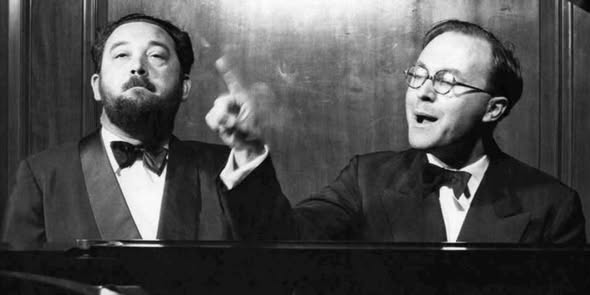
 “Respectable songs for responsible people” were the stock in trade of Flanders and Swann, practitioners of English light music most famous for their live albums “At the Drop of a Hat” (1957) and “At the Drop of Another Hat” (1964), the latter produced by George Martin, also the Beatles’ producer. Michael Flanders (at left in the photo) wrote the words, pianist Donald Swann the music.
As a boy in Detroit, I memorized much of “Another Hat,” including Flanders’ sly references to British and French politics, none of which I understood. A few of the songs and bits are still rattling in my head. Thanks to a timely reminder from actor John Lithgow, one ended up as the focal point of my children’s sermon on Easter Day at St. John’s Cathedral in Los Angeles.
My mother dragged me out of my room to recite some of these numbers at her cocktail parties. She mistook my fascination as evidence of actual promise. A typical Flanders and Swann exercise was their song “Ill Wind,” about a stolen French horn, set to the tune of the last movement of Mozart’s horn concerto in E flat major (K. 495):
I once had a whim and I had to obey it
To buy a French horn in a second hand shop
I polished it up and I started to play it
In spite of the neighbors who begged me to stop
A 10-year-old old belting this out with his changing voice, which my mother said made me sound like a frog, could not have been a pretty picture. But it gave her a chance to brag about our family’s glancing connection with the performers. During a tour of the U.S. and Canada, Flanders and Swann appeared in 1961 at Detroit’s Shubert Theater. I stress that since I come from a family of journalists, none of this is entirely reliable, since we are famous for embellishing our personal anecdotes. But my music critic father, Harvey, had evidently persuaded Michael and Donald to come to dinner at my mother’s and my tiny apartment in Highland Park. My parents had been separated for five years, but this is how they rolled. And the story goes that Flanders, who used a wheelchair, put me in his lap and rolled me up and down the hallway.
At the time, Barbra Streisand had a residency at the Caucus Club in Detroit and reportedly looked in at a Flanders and Swann matinee at the Shubert. That may have put my dad and one of the greatest singers of our time in the same audience. I’ve often wondered if he ever reviewed her, as he did the Beatles, Elvis, and, of course, Flanders and Swann. I do know he interviewed the Supremes in 1965. Going deeper into my parents’ work, and that of my beloved godfather, Louis Cook, will be among many good things to do in retirement. Thanks to newspapers.com, it’s all online now.
But Eastertide remains. Last week, I heard an interview on Fresh Air with Lithgow, who sounds like the kindest man on the planet. Among his many gifts is offering children’s programs. He mentioned that he once used Flanders and Swann’s famous “Hippopotamus Song.”
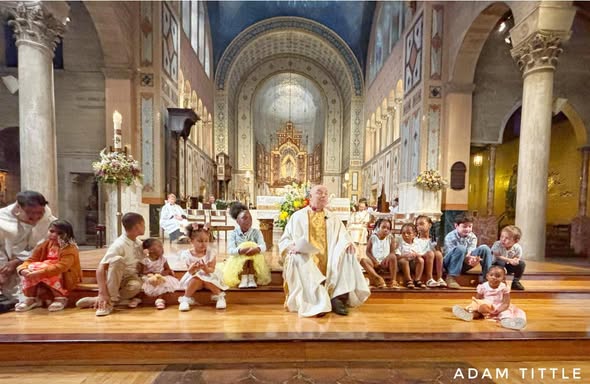 Bingo on the hippos! St. John’s had invited me to offer the children’s sermon on Easter Day, and I had been wondering about a hook. Among my themes was how, when Jesus said he would meet Mary Magdalene and the disciples in Galilee, he was inviting them back to familiar, comforting territory, in preparation for giving them the Great Commission.
I suggested to the kids that they look for Jesus where they feel happiest, especially with their family and friends. Then I asked if any of them was happiest rolling around in the mud. No hands went up, although one child pointed impishly at their younger sibling. I assured them that God has prepared a Galilee for all God’s creatures, including mud-loving hippos. I’m pleased to say that at the end, I had almost everyone in the congregation singing:
Mud, mud, glorious mud
Nothing’s quite like it for cooling the blood
So follow me, follow
Down to the hollow
And there let us wallow
In mud, glorious mud!
[St. John’s photo by Adam Tittle]