
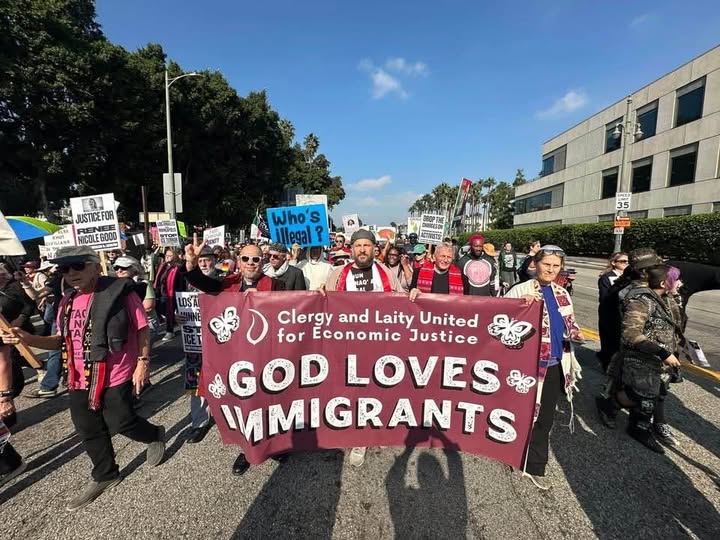
 The prophetic voice is allowed to be practical. If Christian disciples want to help end the catastrophe that Trump is visiting on our country using the immigration issue, in addition to lifting up love and protesting hate, we have to talk more about immigration policy. The outcome may not be everything we wish. Practical solutions to complex issues sometimes mean that we only get half a loaf. But half a loaf is better than going hungry.
At our general convention in Austin in 2015, The Episcopal Church eased the tension over marriage equity thanks to wise, practical prophets, including the Rev. Canon Susan Russell of the Episcopal Diocese of Los Angeles. The church didn’t try to force bishops or priests to perform same-gender blessings. Instead, we made sure to provide for ceremonies in couples’ parishes, with adjustments in pastoral and episcopal oversight as necessary.
This was better than waiting for everyone to come around to the same way of thinking. As it happened, the half-loaf on marriage rite equity fed almost everyone. We should consider a similar approach with immigration.
But first, we have to understand what we want to accomplish. Responding to racist roundups and the killing of peaceful resistors, our natural move is to appeal to the regime’s better nature. The witness of lay and ordained leaders has been bracing and eloquent. But Trump and his operatives are speaking a different language, even where Jesus Christ is concerned. So that will only go so far.
We often quote scripture passages about welcoming the stranger and the foreigner. These appeals to decency and humanity are also lost on a government which has hardened its heart like Pharaoh. Besides, Hebrew Testament passages don’t help us articulate a practical policy. They were set down before anyone, including prophets, conceived of the modern nation state. We of course want a world where everyone can move freely, as God intended. Even if most Americans disagree, the church has every right to advocate for open borders. But it is a little like waiting for marriage equity until all the clergy agree to preside at all weddings.
My guess is that most of our members would want us to follow the middle way. Polls show most people want a common sense policy. Anti-immigrant Republicans killed serious reform efforts three times in the last 20 years. This was a matter of sheer opportunism by those who knew an emotional issue for their base when they saw one.
Trump couldn’t possibly have been more clear. In early 2024, he criticized Republicans who were willing to begin to fix the system because he knew he needed it to stay broken if he was to win. On his orders, they withdrew their support. In his campaign and in office, Trump blurred the vital distinction between immigrant workers who have committed crimes other than violations of the immigration laws and those who haven’t.
The latter group comprises about 13 million people. Some have been our neighbors for as long as 30 years, paying their taxes and sending their children to college and military service. Let’s call on the feds to provide them with residential security (for now, it doesn’t have to be a path to citizenship), confining enforcement to those few who have committed serious crimes and are subjects of judicial warrants. It’s also time to reopen the golden door to asylees and refugees.
Preachers generally don’t like to get into this degree of detail about policy. We default to welcoming the stranger in love. Whether we intend it or not, our hearers generally construe this as a call for open borders. As for the other political flank, some in our pews still favor deportation of 15 million or more, as chaotic and sadistic as that would be. One doesn’t know what to offer a proponent of that view except to say that more prayerful discernment is necessary.
The imperative of resistance in the streets doesn’t preclude advocacy in the halls of power. If as Anglicans, we recognize the virtue of the middle way on immigration, then we should organize ourselves, working closely with our interfaith and ecumenical partners, and advocate state by state, diocese by diocese, congressional district by district, and congregation by congregation. Some would say we were going too far, others not far enough. But it would be a serious effort to deprive a demagogue and his masked men of the issue they’re using to hurt and kill the innocent. That sounds like gospel work to me.
(Photo: Jan. 23 in Los Angeles; Mel Soriano)