
Screenshot
It’s a classic American story. Within hours of the deadly terrorist bombing of the Murrah federal building Oklahoma City in April 1994, a massive posse descended on three teenagers along a lonely stretch of highway between Oklahoma City and Wichita. Officials instantly recognized the sad sacks couldn’t be suspects and let them go. Or so the song goes — Robert Earl Keen’s “Shades Of Gray,” from 1997. Look for it on YouTube.
Like Bruce Springsteen in working class New Jersey, the Houston-born Keen gets his people. Maybe he based this classic folk song on a story someone told him. Either way, it rings true. Wasted on moonshine and homegrown pot, the kids steal a pair of heifers from a family friend, sell them for $900, and set their faces for more high times in Mexico. Two of them are screwups who’d been expelled from high school for vandalism. Pretty dumb not to make the most of a free education. But acting dumb amid relative privilege is the subject of my post. The narrator, the Nick Carraway of the piece (he narrates “The Great Gatsby“), can’t quite figure out why he tagged along, “’cause I was raised a Christian, and I knew right from wrong.”
When the feds find them, they’d pulled over so one of the three can throw up by the side of the road. Choppers, armed officers, and dogs bear down. Then these words in the lyrics:
A Black man in a suit and tie
Stepped out into the light
He told his men to turn us loose
They put down their guns
He said “These are just some sorry kids
They ain’t the ones”
Here Keen achieves greatness. What deep understanding he evinces by making this apparition of supreme federal authority a person of African descent. A hundred, 50, indeed just 20 years before, he would’ve been white. Trump and his operatives would probably call him a DEI hire. Yet in this tale, he sizes the kids up quickly and extends grace. Keen writes that afterwards, they feel “downhearted and alone” — maybe embarrassed to have been put in their places and so quickly judged to be ineffective, and by a Black man at that. Even in real life, when the tables have been turned by someone who has worked hard and overcome centuries of racism to get ahead, people sometimes wonder what the world is coming to.
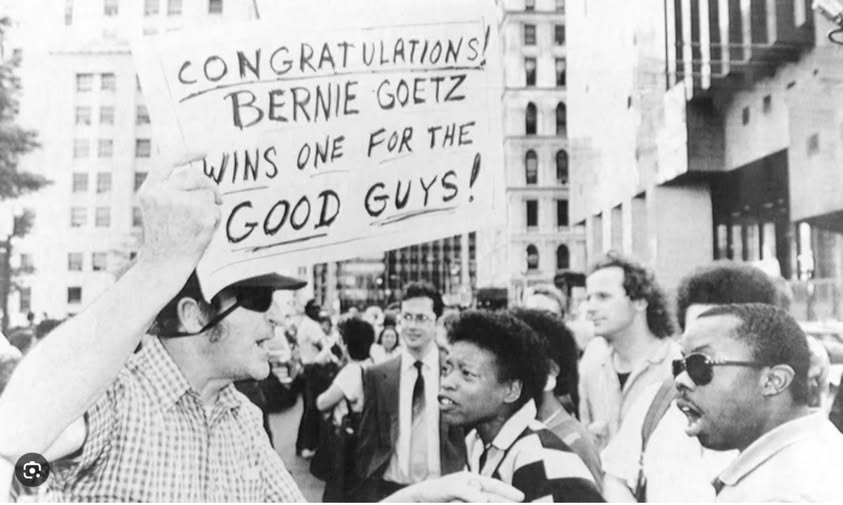
Caught up in the story, the listener wonders whether a white official would’ve let a group of Black kids off so quickly. Those who remember the ballad of Bernie Goetz know for sure. He wasn’t a lawman. He just took it into his own hands. In the New York City subways in 1984, he shot four teenagers of African descent because they asked him for five dollars. They didn’t demand or threaten. They just asked. Their names were Barry Allen, Troy Canty, Darrell Cabey, and James Ramseur. While all survived, Darrell, whom Goetz shot at twice, including once as he cowered on the floor, is living with paralysis and brain damage.
If he had really been scared, just showing them his gun would have been enough. Considered a hero in some quarters, including by New York’s competing tabloids, one of them owned by Rupert Murdoch, Goetz served eight months for a weapons charge. Now in his seventies, he still defends his actions. The kids didn’t have weapons, just screwdrivers they’d planned to use to jimmy the coin boxes in a Times Square arcade. But Goetz didn’t know that. They didn’t brandish them, any more than Alex Pretti did his gun when the Border Patrol killed him in Minneapolis. That didn’t stop Goetz’s champions from saying the kids deserved it because they were on their way to steal some small change.
In her new book about the shootings, “Fear and Fury,” Heather Ann Thompson, interviewed this week on Fresh Air, shows how the kids were victimized by a lack of opportunity in eighties New York, especially the desperate poverty in the South Bronx. She describes Goetz as an exemplar of white rage. Besides the shooting themselves, this is the worst scandal. Because Bernie Goetz was one of the luckiest dudes on the planet. Born into relative privilege, he went to a European prep school and NYU. In 1984, he was running a successful electronics business out of his Greenwich Village apartment. Goetz was one of those people who had it relatively good but insisted he was a victim.
Which I was one night around the same time. I lived and worked in New York City from 1980 to 1985. Heading home late to our apartment in Brooklyn, I was alone or nearly so in a subway car when a young man got on and pointed at me through his coat pocket and demanded money. I suspected it was a finger, not a gun, but I handed him some cash. I felt embarrassment but no racial animus. Nor I had I in seventh grade in Detroit, when I was the only white boy in my class and was occasionally bullied. Kids didn’t pick on me in school because I was white but because I was small and timid, with glasses and big ears.
I claim no moral superiority. It was how I was brought up. I was raised a Christian, as the Keen song goes. My journalist mother, a lifelong Episcopalian, even though she was on her own and struggled financially, taught me that crime and socio-economics went together and the poverty around us was a consequence of society’s shortcomings. She never let me forget that I was lucky just because of the conditions in which I had been born. As a well off-white New Yorker in the eighties, all Goetz had to do was open his eyes and count his blessings. Instead, like Travis Bickle in “Taxi Driver,” riding around the greatest city in the world and seeing nothing but filth, he let rage take over.
Given the racist epithets he was reported as spouting, I suspect Goetz got little enjoyment from his wonderful neighborhood. We used to hang out there. From his apartment on 14th St., he could’ve walked six blocks to the best Indian and Bangladeshi food outside of India and Bangladesh, almost a block of restaurants. The Ukrainian Ballroom on 2nd Ave., for the pierogi and cabbage, was like stepping into a restaurant in Kyiv, with thick old furniture and enormous booths. You could spend a whole day in Strand Books. Goetz could’ve gone to historic Italian bakeries like di Roberti’s, browsed a dozen used record stores, and marveled at the Cooper Union, where Lincoln gave his “House Divided” speech in 1858. Our house is still divided — including by those who have made a religion out of counting their grievances.
(Photo: AP)