
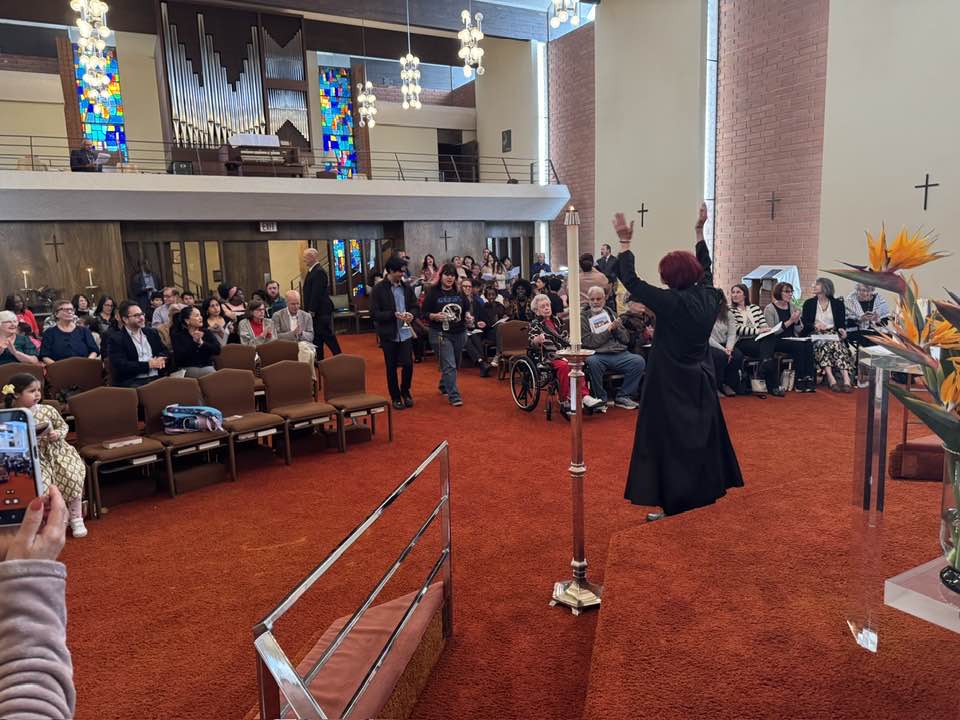
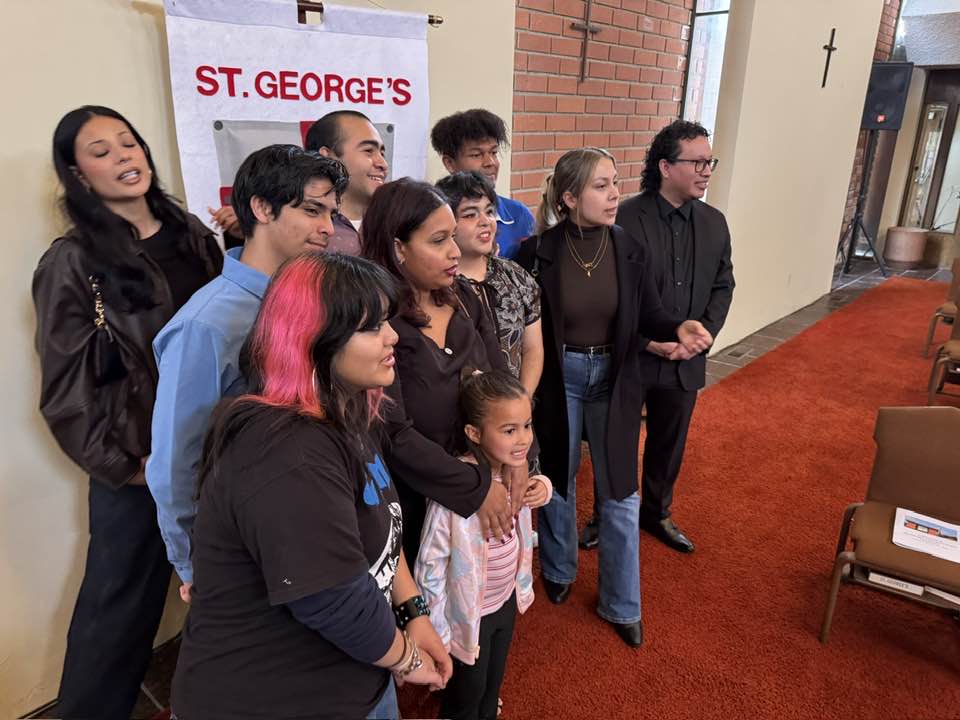
 Laughter and tears, hearty applause and cheers, warm hugs, grateful hearts, bittersweet memories, and a standing room only gathering of good friends and enthusiastic well-wishers from near and far filled St. George’s Church in Hawthorne for the congregation’s final worship service Sunday, Feb. 15, 2026.
“Raise your hands if you were baptized here,” the Rev. Canon Pat O’Reilly, vicar, called out as she welcomed worshippers before the start of the bilingual Spanish and English service, officiated by Bishop John Harvey Taylor. Hands continued to rise as she named other sacraments and memories: “Who was married here? Had their first communion? And I know many of us have had our loved ones buried from here, right?”
The nearly 100-year-old congregation’s decision to end worship was borne of dwindling attendance and financial challenges, O’Reilly told The Episcopal News. It represents the first church closing in the Episcopal Diocese of Los Angeles since 2018, when St. Barnabas Church in Eagle Rock was shuttered.
St. Barnabas reopened a year later as “St. Be, an encouraging Episcopal community in Eagle Rock”. With the guidance of the Rev. Canon Jaime Edwards-Acton and the Rev. Carlos Ruvalcaba, St. Be’s currently serves as a Seeds of Hope food distribution site and a local entertainment venue, hosts a fine arts preschool and weekly bible study. Members of St. Mark’s also have worshipped at the location since their Altadena church was destroyed in the January 2025 wildfires.
Similarly, St. George’s church building will remain open and continue as a South Bay meeting spot for VISTAS, a day program for disabled adults, and several 12-Step Recovery Groups. Once the Rev. Dr. Antonio José Gallardo Lucena is consecrated July 11, he will decide the building’s future course, O’Reilly said.
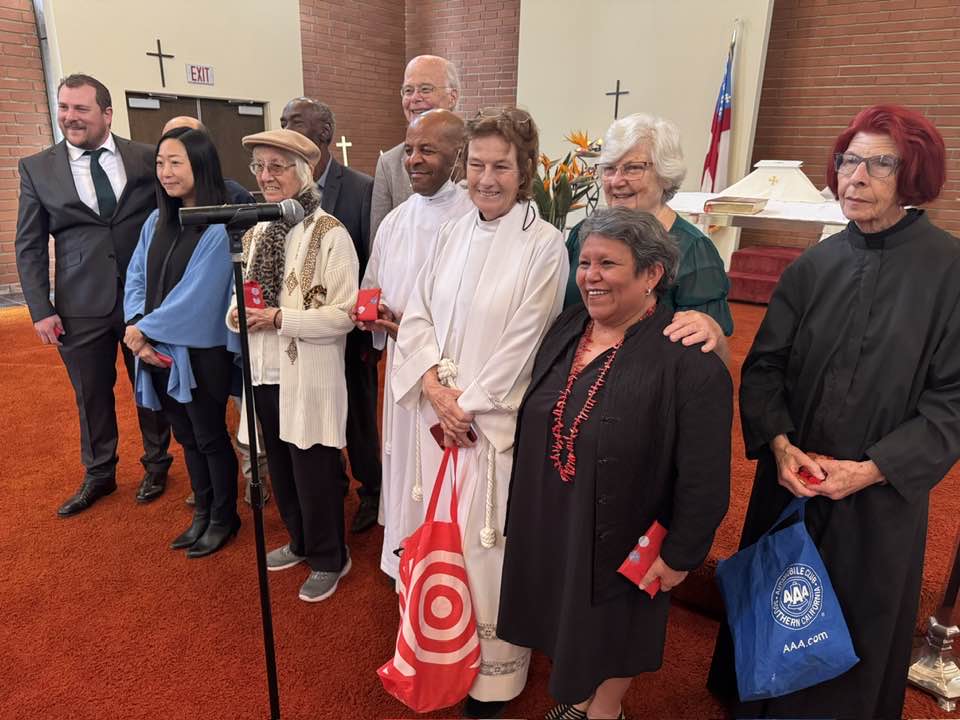 In recent years, average Sunday attendance had dwindled to about a dozen and many in the congregation were aging. The church did not engage the diocesan Requiem or Renaissance initiative. to help churches discern their calling in times of decline or changing circumstances, she said.
“We just decided it was time,” according to O’Reilly, 75, who was ordained a priest in 1983. O’Reilly said she intends to spend more time with grandchildren and continue her service with the Lydia Lopez Center for Community Empowerment, Sacred Resistance and global partnerships. A memorial service for O’Reilly’s former husband, the Rev. Bryan Jones, was to be held the following day.
“God is calling them to a new ministry,” she said of the congregation. “They’re going to enrich others’ congregations. They’re going to give new life and new gifts to other congregations. Yes, this is an end, but they’re being called to a new beginning. It will be enriching for them and for those with whom they worship.”
Taylor compared the congregation to the disciples witnessing the Transfiguration in Sunday’s Gospel passage, citing a variety of churches they might join. “Here’s one thing I know for sure — whatever church you walk into, whenever you decide to take the plunge … you’re going to be reckoned as a small miracle.
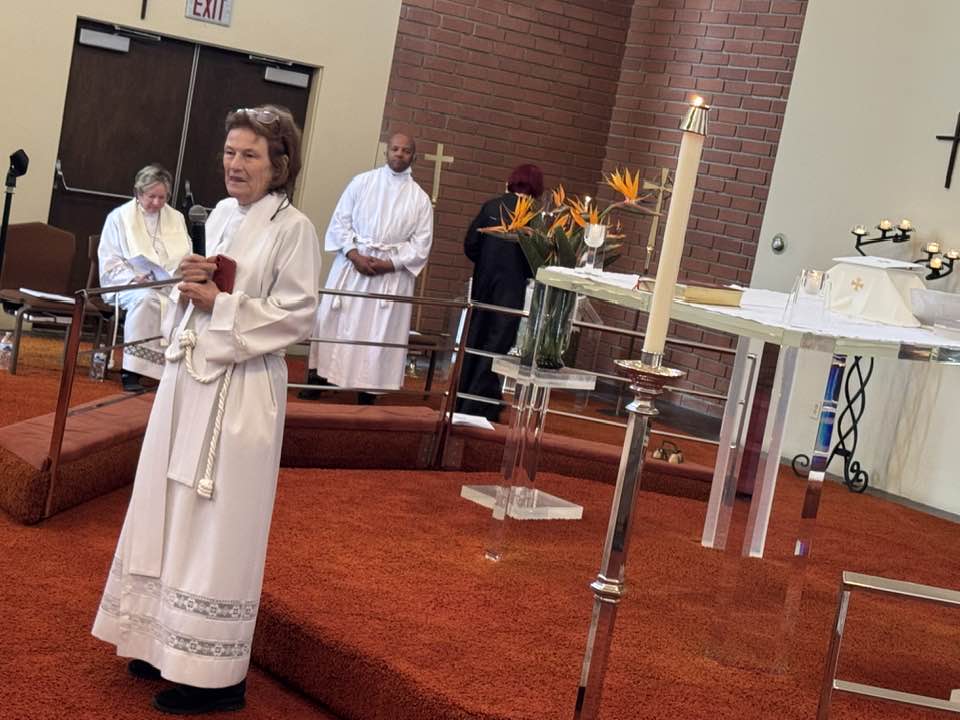 “People are going to see you the same way Peter and James and John saw the light on the transfiguration mountain. You are going to be gleaming with possibility. Your new church is going to need you and put you to work before you know it. Don’t be afraid to say no if they try to make you senior warden in the first two weeks,” he added, amid laughter. “Whatever it is, your place is waiting, and it won’t be filled until you get there.”
Elena Vasquez, widow of the Rev. Martir Vasquez, St. George’s vicar from 2001 to 2012, and a one-time candidate for Bishop Suffragan in the Los Angeles diocese, traveled from Guatemala where she resides, for the service.
“I’m sad and happy,” she said, with tear-filled eyes. “I remember seeing this building and thinking, oh my God, it’s so beautiful. It was so lovely when we were together in this building. Yet I know the people will find how to become church again.”
She recalled how diligently and faithfully Martir, who died in 2023 while serving in the Diocese of Arizona, had worked to build community, going door to door to greet neighbors and to raise awareness of St. George’s.
Dr. Ricardo and Carol Reznicek, members of St. Cross, Hermosa Beach, attended the service in support of St. George’s, recalling a more than 25-year friendship with the church and with the Vasquez family, including mission trips to Belize, to help build a church when Vasquez served there.
Similarly, Michael Adkins, St. George’s organist from 2015 to 2021, traveled from Arizona for the “homecoming”. The musical prelude, “Our Destiny Lies Above” from Hans Zimmer’s Interstellar movie soundtrack, paired with “Joyful, Joyful We Adore Thee”, reflected the day’s range of emotions, expressed by Ronnie Manson.
“It’s a sad day, but there’s also hope,” said Manson, who said he is unsure where he will attend church in the future. “Also joining the service were the Rev. Dina Ferguson and the Rev. Bob Cornner, who had served as supply clergy at St. George’s, along with Archdeacon Emerita Joanne Leslie.
Jane Parks, widow of former St. George’s vicar, the Rev. Ralph Parks, also attended the Feb. 15 service. Parks, who had donated the Robert M. Turner pipe organ in honor of his wife, died in 2015. During his 28-year tenure (1963-1991) as vicar, he oversaw construction of the church at its present location.
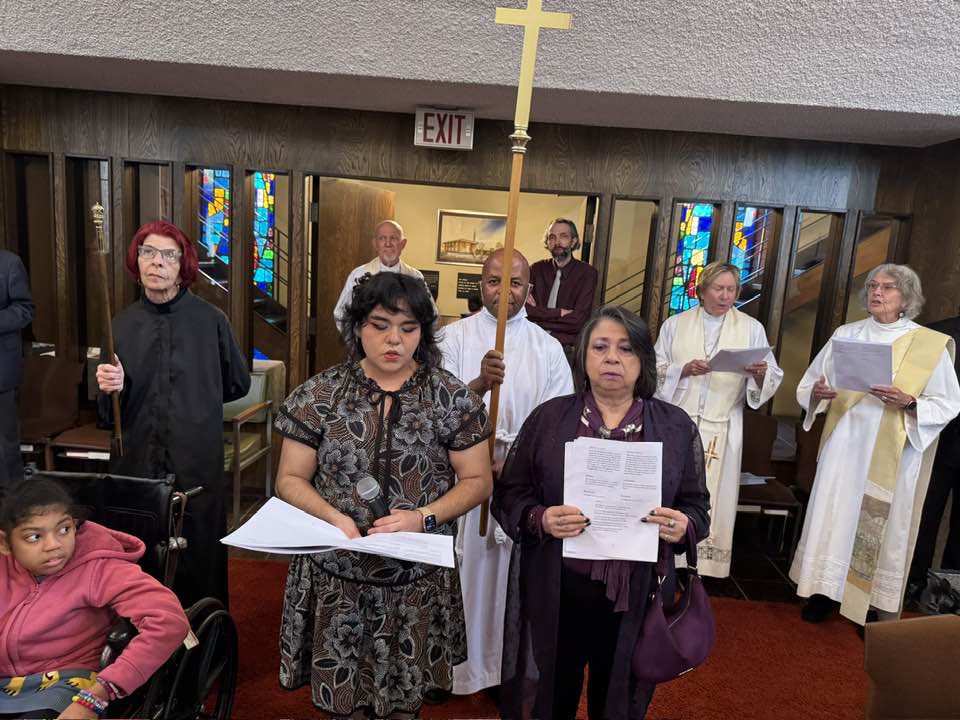 The congregation first met in homes in 1927, and eventually with diocesan aid, began meeting in Army hospital surplus buildings, according to historical notes in the service bulletin. In 1970, members began raising money with car washes, dinners, rummage sales and pledges to for a new building fund. The church was dedicated March 13, 1977, and its first service was held there on Palm Sunday of that year.
Taylor spoke of the uncertainty that often accompanies changing circumstances and wilderness experiences, leaving the “glorious feeling of the Transfiguration, if not diminished, then equivocal and ambiguous. This year, Jesus lights up the church, just in time for us to turn the lights off.”
Jesus is calling upon individuals to grasp their power, their authority to carry on teaching and preaching in his name, Taylor said. Those new churches to which St. George’s members will go will rejoice at their presence.
“They’ll look back and they’ll say, we know it was awful that you lost your church, but as it turned out, God sent you to us at exactly the right time because of the gifts you bring.”
Taylor added: “Our communities and our country are in such a bad way this morning. Besides the normal transitions of losing someone we love, or saying goodbye to a church building, man of our siblings are dealing with so much extra anxiety. People are living in fear because of our federal government’s cruel, racist roundups. This is true in any church we visit in our diocese, and there are well over a score of them, where English is not the primary language of worship.
 “Some of us are saying goodbye to our church this morning. We have siblings in Christ who are afraid to go to church this morning because of ICE and the Border Patrol. So, there’s work to be done with our immigrant worker neighbors and our unhoused neighbors. Every church can use a little extra help.”
There is enough light shining from that transfigured mountaintop, Taylor said, “to guide each of us into our abundant new season of ministry.
“What is that season? We’ll each know it when we experience it. For now, remember the words of our epistle, the sometimes overlooked Second Peter: ’You will do well to be attentive to this as to a lamp shining in a dark place, until the day dawns and the morning star rises in your hearts’.”
For Kyle Tobiason, 46, a third-generation member of St. George’s, it was “a tough day, but a new era. I don’t know which church I’ll end up going to,” he said. “I’ll bounce around at a few before deciding.”