
 On behalf of executive director Eileen Spencer and her board and staff colleagues at the American Friends of the Episcopal Diocese of Jerusalem, welcome to a reception that was to have been in honor of one of the great peacemakers and bridge builders in Israel and Palestine, Archbishop Hosam Naoum رئيس الأساقفة حسام نعوم.
This was to have been Hosam Week in the Episcopal Diocese of Los Angeles. But the United States and Israeli war against Iran made it impossible for him to visit. He couldn’t leave the diocese when his people were at risk. Nor could he run the risk of leaving for fear that someone would find an excuse not to let him return. These are the realities with which bishops of Jerusalem have been living for many years.
In a political setting dominated by extremes, the middle view, the bridge builder’s view, the Anglican view is judged to be inconvenient. It is hard for Hosam and his colleagues because they are Palestinians. Is also hard because he and they want peace, freedom, and national self-determination for everyone in the region. Their dream is inconsistent with the realities of a poisonously polarized setting, where the demonization of one’s opponent is the principal source of political energy.
Yet our Lord did not say blessed are the polarizers, the authoritarians, or the zero sum gamers. Our Lord said, “Blessed are the peacemakers.” Blessed are those who take risks for the sake of what is best for all God’s people.
Sometimes we even find peacemakers in the shadows of their own incalculable losses. A new book, “The Future of Peace: A Shared Journey Across the Holy Land” by Aziz Abu Sarah and Maoz Inon, is destined to become part of the canon of Middle East peace studies.
Maoz’s parents were killed in their kibbutz by Hamas on Oct. 7, when 1,200 died, presaging the deaths of 75,000 at Israel’s hands in Gaza. He and his family mourned. Then they made a statement saying that the response to the Hamas attack should be to work harder for peace.
 Aziz read about their statement. A Palestinian, he was nine when his brother was arrested during the first intifada and charged with throwing rocks at Israeli police. He died from injuries inflicted during his interrogation. Aziz still hadn’t figured out what to do with his agony until he read Maoz’s family’s statement.
They have become friends. They call themselves brothers. And they resolved to travel together the length and breadth of the Holy Land, which as my fellow pilgrims know doesn’t take long to do, visiting places familiar to all of us who have been. I’ll never forget when Kathy and I invited Canon Iyad Qumri of Qumri Pilgrimages, who was staying in Los Angeles, to come to dinner at Olamendi’s Mexican Restaurant in Dana Point. He said we had made him drive twice the width of Israel.
Aziz and Maoz’s book is the result of their travels. They don’t agree about everything. Siblings rarely do.
But they agreed on these words. In the first chapter, they write, “[W]e both believe in protecting human life, ending the bloodshed, and creating a lasting and just peace that is rooted in equality, justice, dignity, recognition, and security – – for all of us…. We do not see ourselves as Palestinians and Israelis, or as Jews and Arabs, but as human beings, who believe in fostering a culture of dialogue, a culture of forgiveness, a culture of peace. To those who see only division lines, we say, if you must divide us, let it be as those who believe in peace and equality, and those who don’t…yet.”
If the archbishop had been able to be here, he wouldn’t have said it quite that way. But he would’ve struck an eloquent note of reconciliation. We have a sense of what he would have said, because many of you and I have heard him say it before.
He would say all sides deserve to be treated with dignity and equity. He would say people are won to the cause of peace soul by soul and heart by heart. And he would say that the dwindling community of Arab Christians is vital to keeping the lines of reconciliation open, especially while others with influence seem to want to divide folks differently than Maoz and Azi. Not as friends of peace today vs. future friends of peace. But as us vs. them and good vs. evil, the either-or formula for scapegoating that is becoming more and more familiar in more and more settings.
And Archbishop Hosam always urges us to speak truth while being careful about the words we use – and never to lose sight of the church, the living stones, in the land of the Holy One.
 We’re here tonight because we are already friends of American Friends or want to learn more. We’re here notwithstanding the hopelessness that seems increasingly to dominate the news from Israel and Palestine. Especially these days in the West Bank, bit by bit and brick by brick, prospects for a Palestinian state grow dimmer and dimmer.
If I may, the three principles which sustain me as an observer of events in the lands I have visited eight or nine times as a pilgrim and fact finder.
First, don’t give up. Keep paying attention. Identify news sources that you trust, making sure some of them originate in the region. Keep in your prayers the relatively younger Palestinians and Israelis who think as Aziz and Maoz do, who work at the grassroots for peace and join hands while their leaders shake their fists.
Second, as soon as we can, let’s go back. Our Palestinian cousins depend on our visits and our commerce, especially in east Jerusalem and Bethlehem. In the meantime, if you’ve been to Ibrahim Abu Rakabah’s St. George’s Bazaar on Nablus Rd., right down from St. George’s Pilgrim Guest House, I would remind you that you can order online from St. George’s Bazaar, Feras Qumseya’s Bethlehem Handcrafts, and other Palestinian-run businesses.
Third, please support American Friends. The Episcopal Diocese of Jerusalem is enormous and complex, comprising institutions in five countries, missions and parishes, service organizations, hospitals, and schools. Its schools are vital sources of superb education for all genders. Please remember what some of the polarizers believe about education for girls.
So you don’t have to figure out for yourself what institution needs your support the most. American Friends and Bishop Hosam are in regular touch. Eileen and her colleagues know what his priorities are, from the Holy Land Institute for the Deaf in Jordan to Ahli Arab Hospital in Gaza and everywhere in between.
Study, visit, and give. This is our Eastertide trinity. We’re heartbroken the archbishop couldn’t be with us, and yet our hearts are full when we think about his courage, eloquence, and deft twinning of the prophetic and the pastoral. Thank you for your prayers and your support for his work.
As we face our own challenges, when the polarizers tempt us with their siren songs, remember that we can all join hands despite our differences. Aziz and Maoz joined hands over the graves of loved ones. We can all follow Archbishop Hosam’s example of building bridges and stressing reconciliation, despite the risks of standing in the middle way. Because, after all, in the end, these are the only things that work if we want more peaceable lives and a more peaceable world. If Aziz, Maoz, and Hosam can do it, we all can.
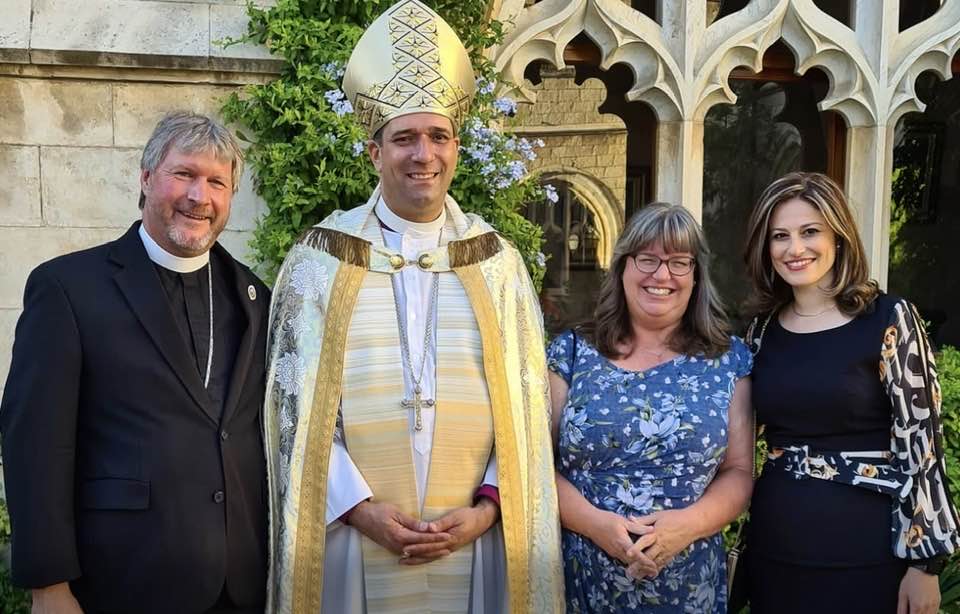
[My remarks Saturday evening in Los Angeles at an American Friends reception as its board meeting came to a close. Hosam is shown in Jerusalem with his chaplain, the Rev. Canon Don Binder, and Chris Binder and Rafa Naoum.]