
 Good morning, Breakfast Clubbers! I believe that’s the fifth time I’ve had the privilege of offering that immortal greeting. I was here twice to talk about Kathy’s and my old boss, President Nixon, then twice to talk about my work as Episcopal bishop of Los Angeles, which draws to a close in July after about 10 years.
Mind you, I’m not actually 100% sure that this is my fifth visit. I could’ve looked it up, but that would’ve been risky in view of my plan this morning. As the son of journalists as well as a preacher, I reserve the right to embellish and enhance my personal anecdotes. Reporters do their best to get it right in their articles, but then, after deadline, they wax creative.
My vision is to say that I talked to you twice about the earthly and profane, namely about Mr. Nixon, until recently our most controversial modern president. Then I talked to you twice about the work of the church, which, rather than earthly and profane, is at least theoretically sacred and profound.
My sleight of hand in those first four speeches was to make both Nixon and the church smell as sweet as possible. And now, inspired by our city’s most famous fictional detective since Philip Marlowe, Harry Bosch, for my fifth magic trick, I propose to split the difference — to identify what the worlds of secular and sacred events have in common when it comes to core moral values.
I’m beginning with Harry’s proposition – what he described in his 1995 novel “The Last Coyote” as his mission statement as a homicide detective – and I’m heading for the golden rule, which I reckon as the law of nature itself.
 In “The Last Coyote,” Harry’s epic temper had gotten the better of him, and he was meeting with the LAPD psychiatrist and struggling to keep his job. According to the life story imagined for him by novelist Michael Connelly, revealed over the course of 20 gripping novels, taking us from the early nineties to the present, Harry was the son of a sex worker. His mother was murdered while he was living as a ward of the state.
No one had cared enough about her and her murder to devote any attention to solving it. So Harry solved it. From this and other experiences – from seeing the way society devalues certain individuals or classes of individuals – Harry developed the philosophy that “everybody counts, or nobody counts.”
Of course, this is a low bar. I think we all agree that every murder ought to be solved. But when you apply Harry’s proposition more broadly — in a society engaged in the eternal struggle over who gets what and when and how much – when you look at a whole society or system and apply Harry Bosch’s yardstick – “everybody counts, or nobody counts” – that kind of thinking could get pretty expensive.
Expensive indeed if you find yourself saying everybody deserves enough to eat and a place to lay their head. A decent job to give them a foothold in the world. A safer place to be when their mental illness or addiction causes them to act out on the streets.
But we don’t have to make it a political conversation just yet. It’s actually pretty easy for us to act toward people as if they don’t count.
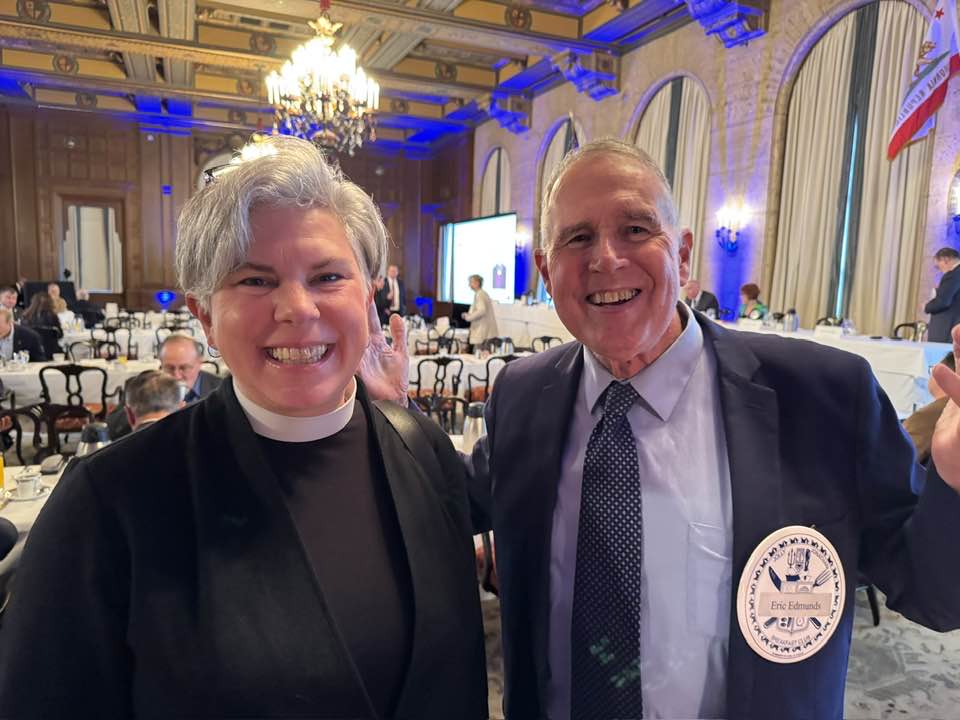
A note about my gracious introducer and fellow Episcopalian, Eric Edmunds. You know him as a breakfast clubber and a brilliant attorney. He’s here with his priest from The Parish of St. Matthew in Pacific Palisades and my beloved colleague and friend of many years, Melissa McCarthy.
 Eric may or may not have had a chance to tell you that the church ministry he has enjoyed the most has been visiting incarcerated folks in Sheriff Luna’s prison system. He talks about it all the time. He believes that everybody deserves to see a smiling face every once in a while. Everyone needs to be listened to and heard, no matter what agonies they have inflected or borne. Eric and our other prison ministers and chaplains aren’t there to ask what the prisoner did wrong. We don’t want to deepen their guilt and shame. Eric goes so he can tell incarcerated people that they haven’t been forgotten.
Kathy and I are proud of her daughter, Meaghan, a social worker who spends two days a week counseling inmates in a state prison. She says that social services are so dismal that the only way some incarcerated folks can get noticed, the only way they can get a little TLC, is by pretending to be sicker than they are.
Of course some might argue that they don’t deserve TLC. But not Meaghan. Not Harry Bosch. Not Eric Edmunds. They say, “Everybody counts, or nobody counts.”
Besides, it’s not just prisoners who feel isolated. We may give ourselves permission to say that certain people are beyond the pale and don’t count anymore – but what happens when it’s someone we love?
You may remember Arsenio Hall’s syndicated talk show in the eighties and nineties. He’s just published a memoir, and he was interviewed about it last week on NPR’s Fresh Air. He said when he first came to LA, two of the most famous people in the world took him under their wings — his future competitor in the talk show world, Jay Leno, and comedian Richard Pryor.
Not long after, Pryor was diagnosed with MS – and one day Arsenio learned that his friend was alone most of the time, sitting in a room, watching television. So near the end of Pryor’s life, for about a year, Arsenio went and sat with him, just to talk and watch TV.
I can relate to this as a pastor. People who get sick often stop hearing from their friends, sometimes even from their relatives. When someone’s dying of cancer, we usually don’t feel comfortable calling them up or going to see them. We assume their family and best friends are taking care of that. We figure they must have pastoral support or counseling.
Or we think that they won’t want to be bothered. When it’s really us. We don’t want to be bothered. Not that we’re lazy or don’t care. But it’s hard to be in the presence of suffering when there’s nothing we can do to fix it. And so the phone of one of the most famous people in the world, Richard Pryor, stopped ringing.
Right now, each of us has someone in our lives in this situation whom we can call or text. Experts say that the chronically ill almost always feel isolated and lonely and that feeling isolated can make them even sicker. We don’t want that to happen – because, like Harry said, “Everyone counts, or nobody counts,” whether we’re in jail or free, whether we’re sick or healthy.
Some of you movers and shakers may even know Michael Connelly. He’s written many other novels in the Bosch universe, including the Lincoln Lawyer and Rene Ballard series. He used to be the police reporter for the Los Angeles Times, where my mother worked for many years as associate editor.
His books are as carefully reported as his articles were. Read them for a hard-nosed, Parker Center-centric recent history of Los Angeles, from the repercussions of the Ramparts scandal to the Rodney King crisis, right up to some of the struggles of recent times.
In November 2022, I had lunch plans with a friend from Orange County. He’s a train buff, so I was going to meet him at Union Station. Once before we’d eaten right at the station, at a restaurant called Traxx, but my friend Roy told me he’d gone online and read that Traxx was still closed because of the pandemic. I said to him, “I don’t know, Roy. I just read Michael Connelly’s new book, ‘Desert Star.’ A couple of characters are making lunch plans, and one of them said that Traxx had recently reopened.” It turned out that the Connelly novel was up to the minute, and the whole Internet was wrong.
 If you haven’t read the books, you might’ve seen the TV series. Bosch is damaged, haunted, sentimental, suspicious, and unfailingly loyal. He tends to break the rules and has deep disrespect for authority. He calls political influence that interferes with good police work “high jingo.” But deep down, he’s a softie. In the third Bosch novel, “Concrete Blonde,” Connelly writes, “Bosch knew that hope was the lifeblood of the heart. Without it, there was nothing, only darkness.”
This is where the hard-boiled crime novel intersects with the season of the hard-boiled egg. In the Christian church, Easter is the 50 days following Easter Day, on the way to the feast of Pentecost. Every Easter preacher probably got around to hope at one point or another over the last two Sundays. So too our Jewish and Muslim siblings during Passover and Ramadan.
Hope that things will turn out all right even when our lives and the world are chaotic. Hope that God or someone is expressing some essential benevolence. Hope that the arc of the universe will bend toward justice. Hope the planet and civilization and the stock market will survive.
Harry Bosch would probably define hope as trust — that we’ll find our way to a world that really lives into the proposition that everyone deserves to be treated as though they count, that everyone has the right to be treated with respect and dignity.
And as it turns out, Bosch’s law has an antecedent. We call it the golden rule. I think if I asked each of you to state it, you could, because it helps makes us who we are at our best.
Some of us grew up in classrooms that had posters on the wall showing that almost every religion and philosophy enunciates the golden rule. Confucius lifted it up in China 500 years before Christ. Christians say, or should say, the Christ didn’t invent it. Our belief is that Christ died and rose to prove it.
We read it in Matthew 7:12: “In everything do to others as you would have them do to you; for this is the law and the prophets.” Twenty-one words. The shortest sermon ever. Jesus saying that every of the Hebrew Bible he knew – every name and narrative, every bloodcurdling slaughter and hard-to-believe miracle – it all added up to same thing.
If you want to be treated kindly, be kind. If you want to receive love, give love. If you want to be safe, make others feel safe. If you don’t want to be alone, then find someone else and lay waste to their loneliness.
 So all the things that Bible believers sometimes argue about – whether the world was created in seven days, Noah rode around in an ark, or Moses parted the Red Sea – if Jesus was in the room, he would smile indulgently while we exhausted ourselves with our arguments and then say, “Please just go love your neighbor as yourself.”
To broaden this to the Hebrew Bible, if as Jeremiah prophesied, God wrote the law on our hearts at the beginning of all things, surely the golden rule is the law Jeremiah meant. Going all the way back to Torah, where God pleaded in vain with Cain to do the right thing, surely he was appealing to Cain’s instinctual understanding of the golden rule. God was saying, “Son, I know you’re angry at your brother, Abel, but don’t hurt him. Think about things from his perspective, and put him first.”
When I did marriage counseling as a parish priest, shiny couples would come in full of love. I would warn them that within a year or two, chances were fair to good they would be going nine rounds over whether the steak knives should be put in the dishwasher blade down or blade up.
I would tell them about the only argument I allowed them to have. I wanted them to come in after two years of marriage, and one of them would tell me: “I’m not going take this any longer! From now on, I insist that we go to the movie and the restaurant that my spouse wants to go to!” In arguments like that, if spouses insist on having it the other’s way, there are only happy endings. If everybody counts, if everybody thinks first about the interests of other people, if all of our moral gravity is focused on others, you’d have a world in perfect balance and mutuality.
As it turns out, the universe looks that way already. Thanks to the Integrity astronauts, we’ve been reminded that the heavenly bodies, conducting their exquisite ballet, operate according to the golden rule.
Engineers sitting at their MacBooks knew that when Integrity was in its high Earth orbit two weeks ago, and they fired up that converted old space shuttle engine for a little over five minutes and set off for their half-million-mile journey, they knew it would slow down and come back to earth like a yo-yo, because it was captured and cradled in the arms of the moon’s gravity, which handed it back to the earth’s gravity like a parent handing a baby in swaddling clothes to another parent.
It bears noting that when Integrity pilot Victor Glover — native of Pomona, graduate of Ontario High School — beheld the earth glowing like a jewel cushioned in infinite darkness, he said it made him think of the golden rule.
Back on earth, we follow the golden rule by committing kindness for kindness’s sake and love for love’s sake, never, never, never committing cruelty or violence for their own sake or to score a debating point or obtain political advantage.
In the end, it’s the only thing works. We couldn’t have gotten here this morning without following the golden rule on the freeway. We can’t keep a happy home for two weeks without the golden rule.
And yet we’ve not yet found a vocabulary for insisting that those who wield the power of life and death over millions should obey what most of us take to be the law of nature. This has nothing to do with the separation of church and state. The establishment clause of the First Amendment was designed to protect people from the imposition of a state religion, namely Anglicanism, since most of the founders were affiliated with the Church of England, my church’s antecedent.
The First Amendment protects the people from government, not government from the people. It doesn’t shield an indecent government from being judged in the light of decent values God and people of faith hold dear.
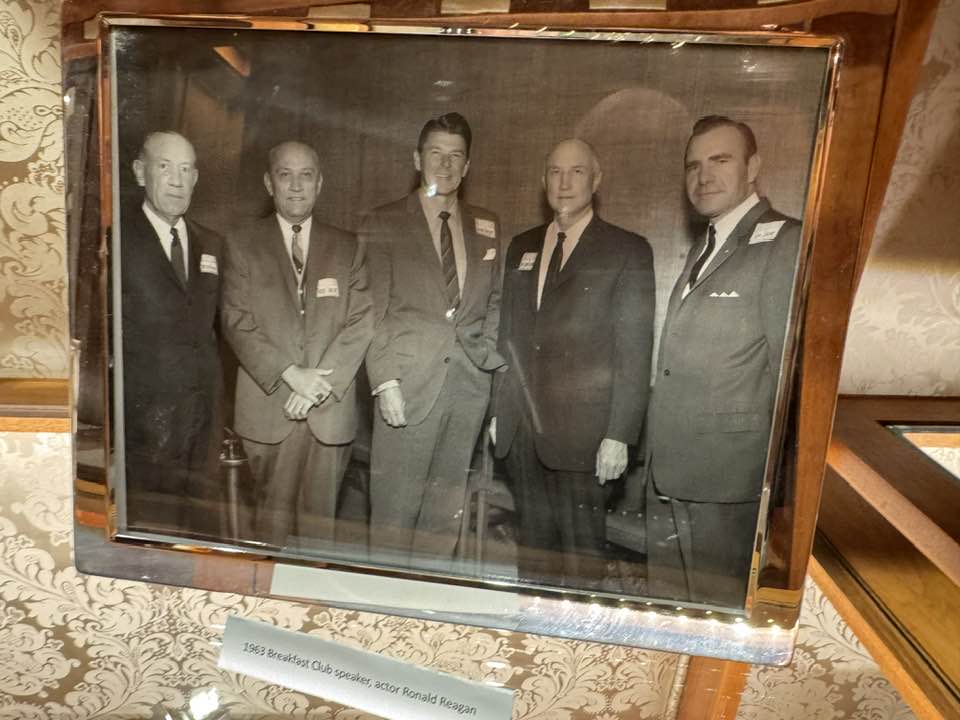
The golden rule is neither conservative nor liberal, Republican nor Democratic. Of course political and policy practitioners will tell you that a dangerous world is not the place to default to idealism and think the best of your enemy. One day, President Nixon was sitting with his national security advisor, Henry Kissinger, and the brilliant late prime minister of Israel, Golda Meir. The president said that his geopolitical golden rule was to do onto others as they did to you – and Kissinger added, “Plus ten percent.”
But somewhere between the poles of naïveté and cruelty for cruelty’s sake lies a golden mean where humanity and decency always get their due. We can secure our borders without cruelty to immigrant workers. We can protect our nation without unjust, inept wars. We can and learn more about our trans and non-binary siblings without dehumanizing them and exposing them to danger and death because of sadistic words and policies.
Speaking of immigration, undocumented people from Central America have been picking our produce in the California central valley for close to a century, paying their taxes without representation. I’m pretty sure that’s what led to the American revolution.
We could take 20 people, representing both parties and a broad range of views on the issue, and lock them in an Embassy Suites over a long weekend. Assuming they had a big enough pot of coffee and enough catering, they would come up with a compromise plan.
Both sides would get half a loaf. That’s better than going hungry. Marco Rubio himself was part of an effort nearly 20 years ago to fashion a great compromise on immigration. But too many politicians wanted to keep the issue raw so they could get power and keep power. When you have a problem that good people with differing views could solve, but you let that problem fester for political advantage, and then you go out and hurt people graphically to make a point — that’s a sin, and the only fix is the golden rule.
About 160 million Americans practice some tradition that has the golden rule at its core. The question is how we express ourselves with one voice. In my view, the political parties as currently constituted aren’t up to the job, so followers of God must at last organize ourselves in such a way as to punish golden rule offenders ruthlessly at the polls and send them home to learn some manners.
Some European nations have Christian Democratic parties. In Germany, the CDU twins the social gospel with political and economic liberalism – that’s liberalism according to its classic definition. Capitalism with a sturdy safety net, as required by the golden rule. If we found a way to apply the principle in our country, I’d call it the All-Faith Democratic Union.
Harry Bosch had his limitations as a prophet of justice. I should put this in the present tense, because the Bosch novels are still coming, thanks be to God and Michael Connelly. Harry’s a good dad. Unlucky in love, he treats the women in his life with a kind of uncompromising grace. But by and large, he sticks up for the dead — victims of murders whom the system overlooked and devalued.
We want to bring his principle fully alive in the land of the living. Each of us in our way have opportunities all the time to be golden rulers – to pause before insisting on privilege or prerogative – maybe just by letting a friend who keeps making an idiotic argument get the last word for once.
Our personal cosmology may or may not open us to the belief that every person on the planet was created for a precious and unique purpose. It happens to be my belief. Believing, with Harry Bosch, that everybody counts helps me be kinder when I’m tempted to be harsh, curious when I’m tempted to be indifferent, generous when I’m feeling stingy.
It even helps me get out of the way when some bonehead tailgates me on the freeway. I can’t actually know why they’re in a hurry without asking them. Sometimes I imagine they’re driving a woman in labor to the hospital. The golden rule tells me to give them the benefit of the doubt. They may be annoying, but they count as much as I do. Giving the other person the benefit of the doubt helps restore balance to the universe. And ironically enough – and here’s the real magic — being kind for the sheer joy of it inevitably makes our lives more joyous.
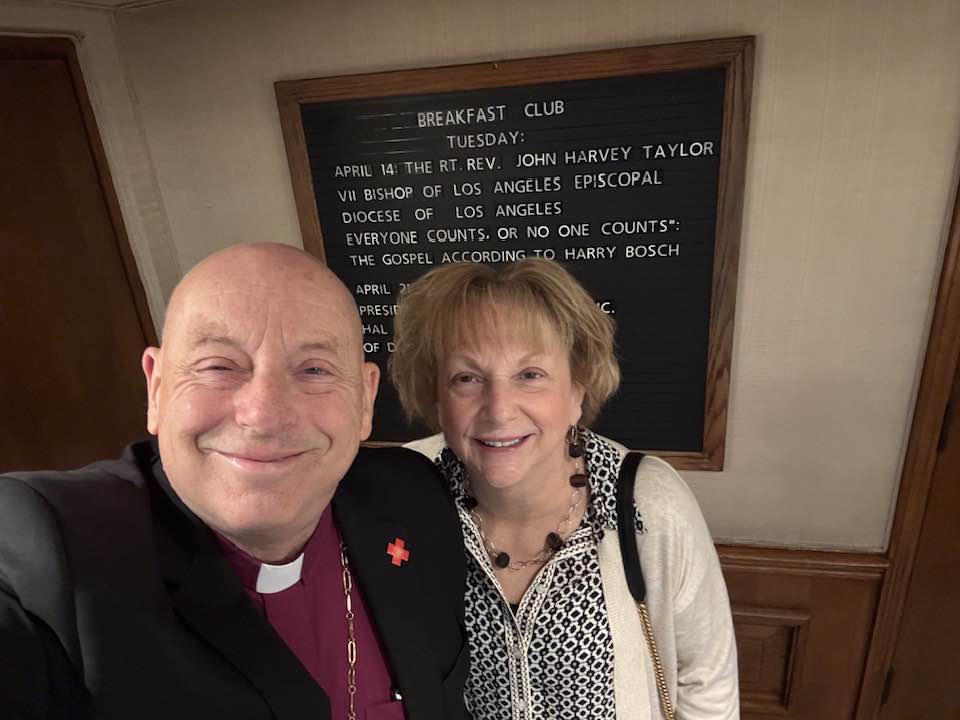
[My speech, “Everybody Counts or Nobody Counts: The Gospel According to Harry Bosch,” and photo album from Tuesday at the Breakfast Club, a program of the Jonathan Club in downtown Los Angeles.]