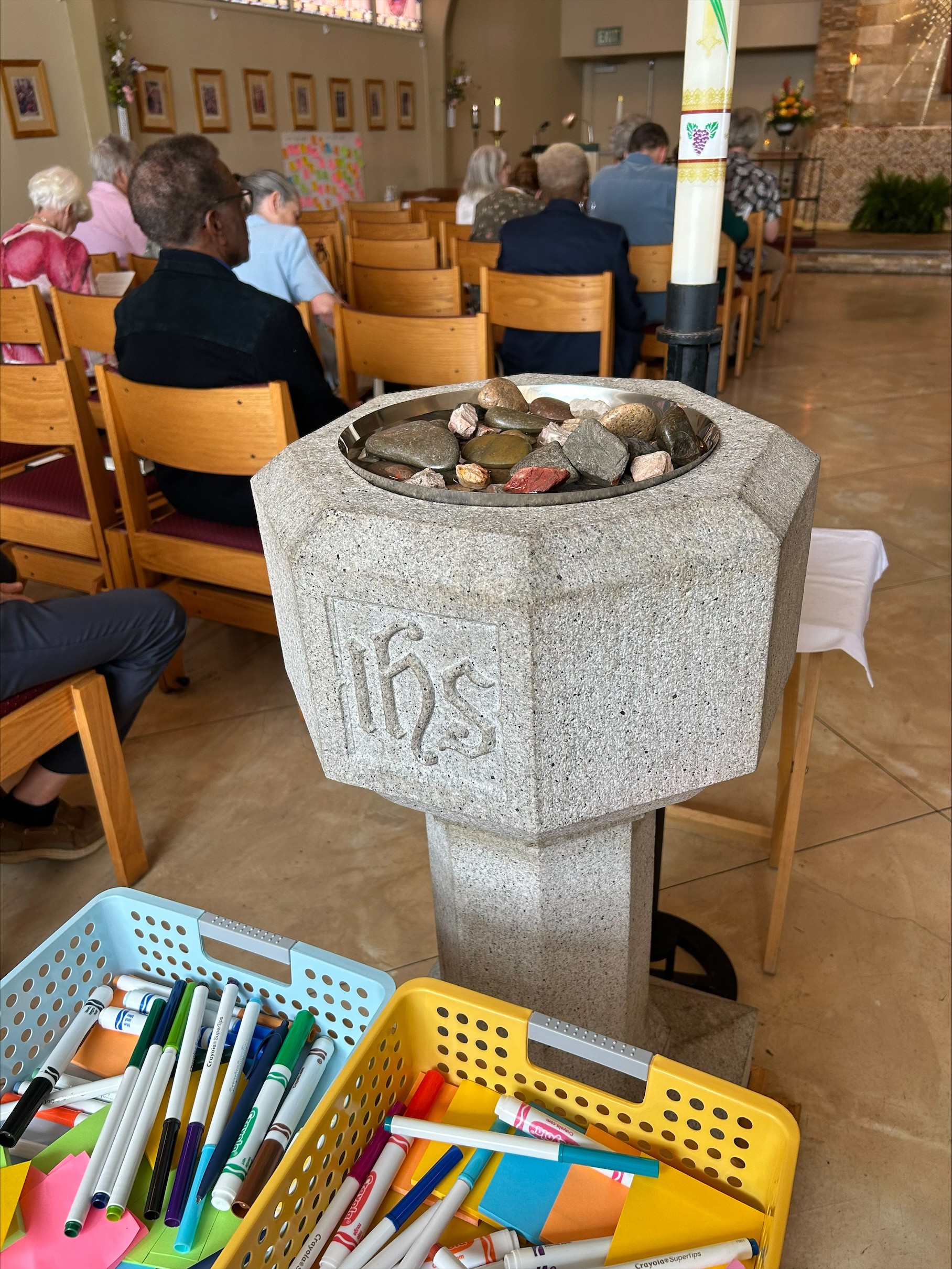
 Two-year-old Oliver and other members of St. John’s Church in Corona “walked” a symbolic road to Emmaus during an intergenerational worship service on a recent Sunday morning.
Together, they placed, in the baptismal font, stones representing “what you are carrying in your heart,” according to the Rev. Patricia Stansfield, rector. “Two disciples walked a road, carrying confusion, grief, and hope,” she said. “We walk that same road. We also walk with Jesus, carrying our own hopes and our grief.”
The movement continued, as portions of the gospel (Luke 24:13-29), were read at four stations created throughout the church. At each station, worshippers received a prompt, to assist delving deeper into the well-known gospel lesson about the two disciples who did not recognize Jesus in their midst.
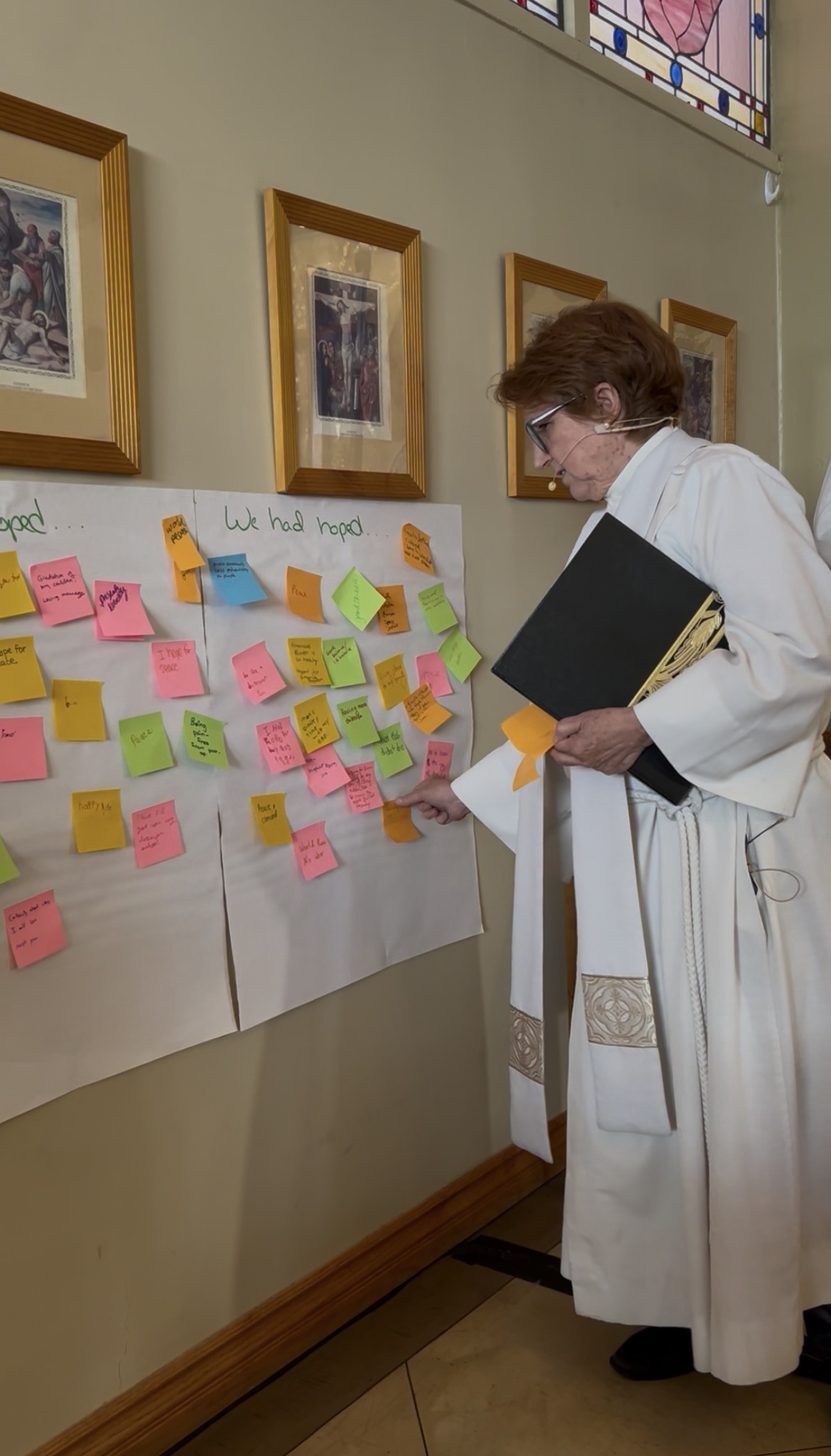
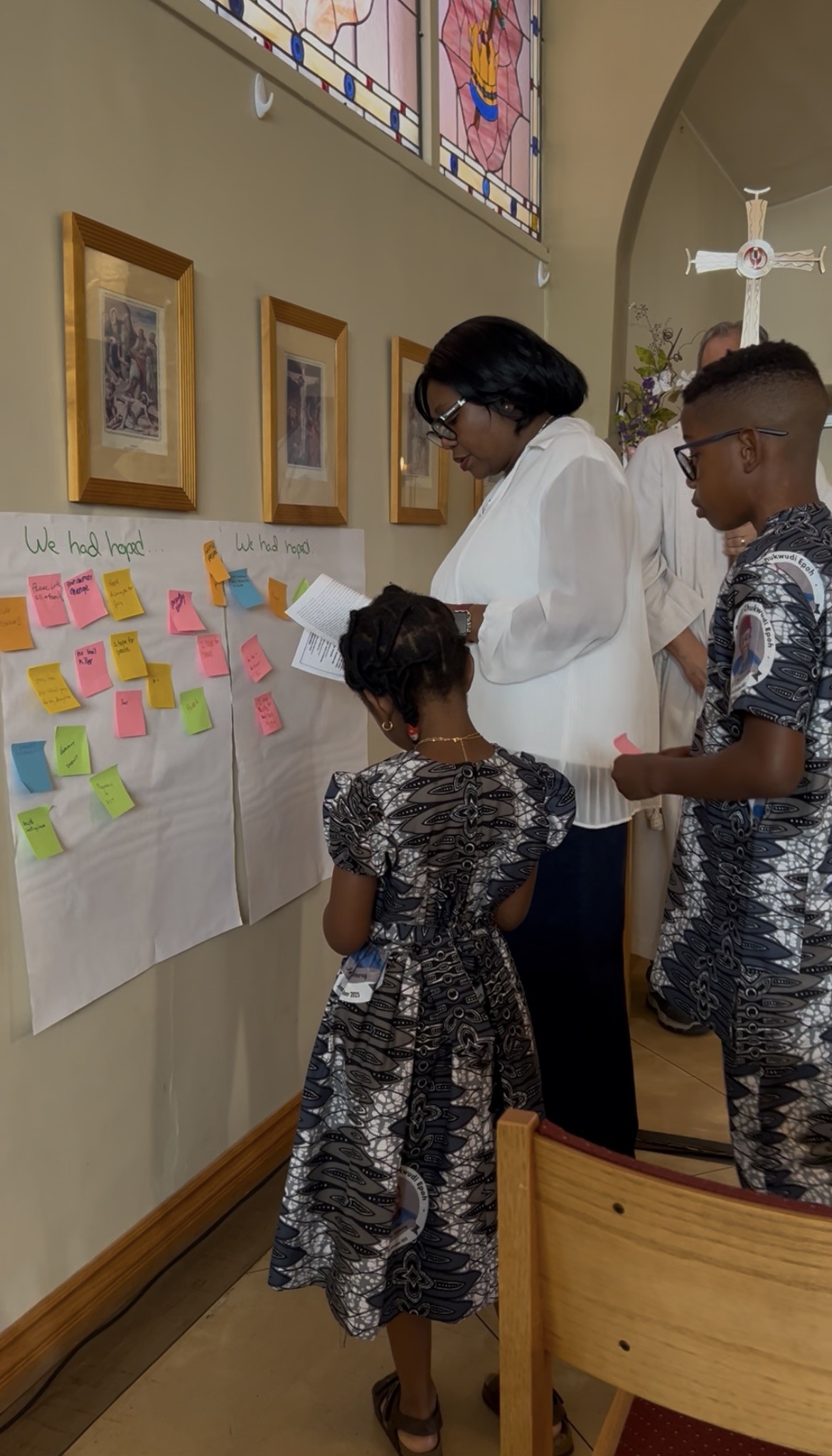
Sticky notes were provided so worshippers could share and post to the church wall, an unfulfilled hope.
“We heard that the disciples had hoped. They had hoped Jesus was the Messiah, and they were disappointed. They couldn’t see the end of the story yet, and so for each of us, that’s a part of the story as well. There are things we hope for that don’t always pan out the way we anticipate,” Stansfield said. “They don’t always turn out on a timeline the way we hoped they would.”
Next, at station three, a lectio divina invitation to listen for and to share whatever God’s voice might be saying. “On the journey, there came a time when they were listening to hear God’s voice and that’s our experience too,” Stansfield said.
“Every time we listen to God’s word, it speaks to us differently,” she said. “We hear different words, different messages. It speaks to us where we are on our journey in that very moment. What might God be showing you that you haven’t seen before?”
“Stay with us Jesus,” the worshippers were prompted, to write and to share aloud prayers on cards at a fourth and final station. And the prayers flowed: “Stay with us Jesus, in our… neighborhoods… health… hearts, minds and thoughts… leadership… as we cry.”
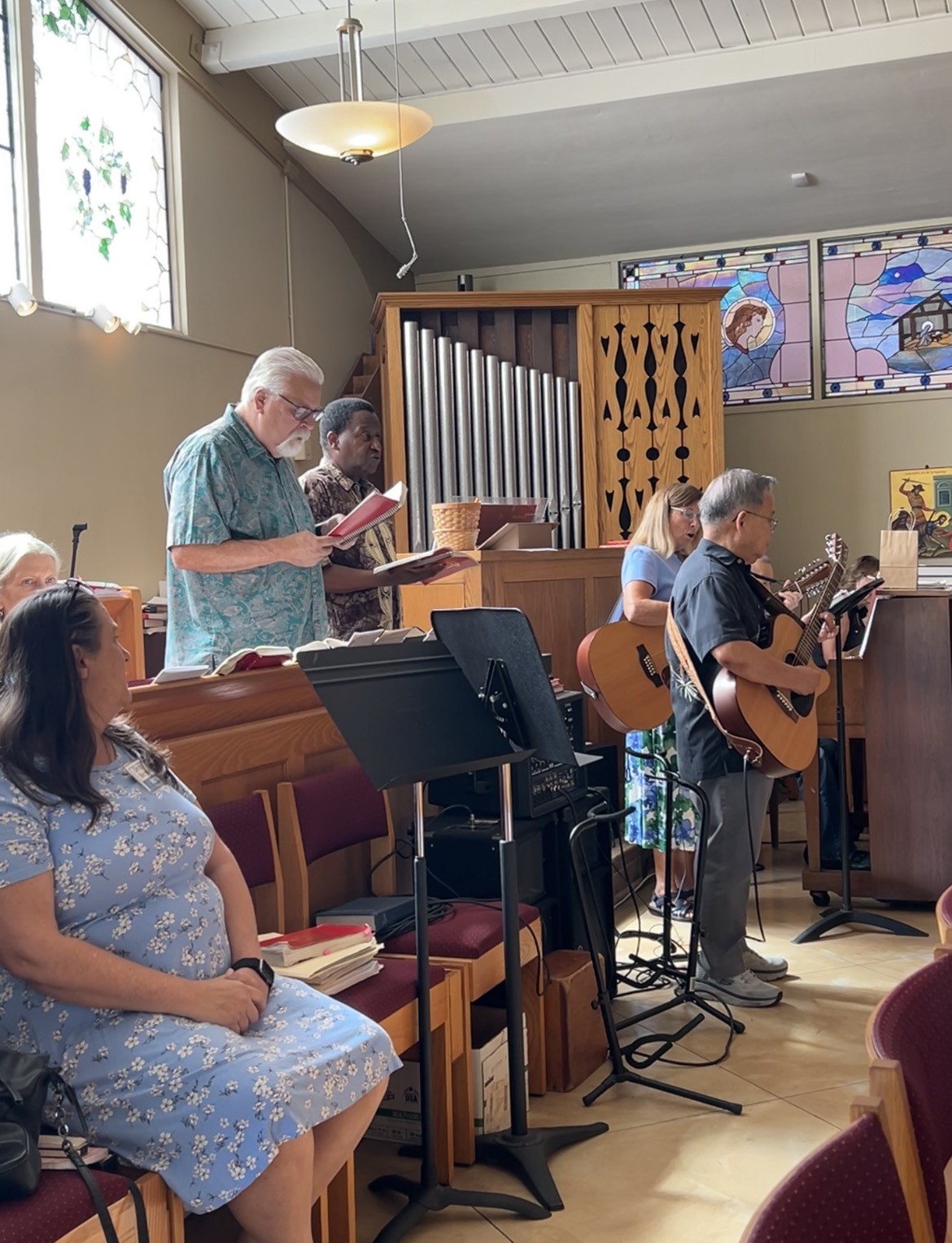 “Just as the disciples on the road made space for Jesus and wanted him to stay with them, so we also want Jesus to stay with each of us,” Stansfield said. “We want to know that Jesus is present to us. The question is, where are you longing for Jesus to stay? And who might you be invited to welcome into your life?”
Although different from the congregation’s usual Sunday morning worship, the experience was designed for participants to experience more deeply the gospel and to explore “what it means for children to be part of the Body of Christ and fully engaged in worship,” Stansfield told The Episcopal News.
St. John’s had received a grant to create a “soft space” or a dedicated space for children in the church. The grant was offered through the Immersed in Worship: Welcoming Children into Intergenerational Worship Initiative, a four-year $1.2 million program funded through a Lilly Grant and overseen by Missy Morain, diocesan missioner for Christian formation, children and youth ministries, Stansfield said.
Morain, who attended and helped design St. John’s April 19 worship service, said intergenerational worship “is what we should be doing all the time. Multi-generational worship is mostly what happens, in that we have multiple generations in our Sunday services.”
 There is no one way to engage intergenerational worship, said Morain, who encourages congregations to reach out and to invite her to support their worship. Bags with stones, sticky notes, cards were provided for St. John’s members with mobility issues or who chose not to join the “walk to Emmaus,” she added.
“The congregation engaged intentionally and very deeply,” she said of St. John’s. “It really just means being flexible and to acknowledge that a worshipping community has bodies with different needs and for us to respond not with rigidity but with welcome and grace.”
Multigenerational worship typically means different generations being present together while intergenerational worship “refers to active interaction and relationship building and shared activities between people of different ages,” she said.
Often, congregations who “mostly serve older populations don’t think intergenerational worship is for them, but it’s important to remember that all our churches have multiple generations,” Morain said.
 “There could be people who are 90 and people who are 70, and that’s two generations. If we are truly welcoming to the whole Body of Christ in worship, it is important to intentionally engage equally the needs of those generations present and to value their gifts.”
Immersed in Worship is intended to engage grassroots ministry to, by, and with children while equipping congregations to be places that nurture children and those who love and care for them, she added.
Launched in 2025, the effort focuses on enhancing children’s engagement in worship through grant-funded projects like children’s choirs and music programs. Local congregations awarded first-round grants included: St. Ambrose, Claremont; St. George’s, Hawthorne; St. John Chrysostom, Rancho Santa Margarita; St. Paul’s, Tustin; St. Timothy’s, Apple Valley; St. Wilfrid of York, Huntington Beach; and Trinity, Orange.
Morain said applications for a second round of Diocesan Innovation Grants for Christian Formation and innovative intergenerational worship, ranging from $250 to $5,000, are being accepted through mid-July 2026.
A grant-writing workshop is scheduled for May 13. For more information, Morain can be reached at: mmorian@ladiocese.org.