
 In Steven Spielberg’s new movie “Disclosure Day,” a whistleblower threatens to publicize files about interplanetary visitations. Among them is a video showing President Nixon in 1973, trying to impress a Florida tycoon by taking him to a morgue at an Air Force base and showing him the visitors’ bodies.
When Kathy and I saw it Friday, I nudged her at the Nixon scene. She’s the only person I know who ever asked a president if they’d seen UFO and Area 51 secrets. This was after his resignation. She was serving as his chief of staff in the early nineties. She recalls him looking bemused and saying, no, he hadn’t had time for that kind of thing.
She said she felt a little silly raising it. She needn’t have. Nixon comes up quite a bit in UFO lore. The Spielberg scene is based on an old rumor that he showed the bodies to comedian Jackie Gleason. Another story circulated in eastern European circles that UFO evidence was concealed at the Nixon library in Yorba Linda. Though I was director for 17 years, and the only safe on the premises was in my office, no one told me about the alien artifacts. I’ll admit to dreaming up the title for a small exhibit the library did on Nixon and the space program: “Area 37.”
Spielberg believes ET exists based on statistical probability and numerous, seemingly credible accounts of sightings. This isn’t a Roger Rabbit hole where I spend much time. But we just haven’t seen any real evidence. One might respond that officials are covering it up, as Nixon did with Watergate. But covering up something as gigantic as alien visitations or political assassinations, such as President Kennedy’s, would be a matter of breathtaking complexity and expense. Conspiracists’ blind spot is the human element. People can’t keep a secret. We began learning the truth about Watergate within weeks of the break-in, as government investigators began leaking to the press. We all know how this goes. Knowing a secret, even that someone in the family is engaged or expecting, is exquisite agony. Kathy knew Nixon as well as anyone outside his family. If he’d met ET, she’d have gotten it out of him.
So it’s a myth that Nixon participated in the coverup of a myth. You know all the arguments. Someone somewhere out there finding us is as hard as it would for us to find and visit them. But “Disclosure Day” is a fable, not a documentary. Most critics compare it to Spielberg’s masterpieces “Close Encounters of the Third Kind” and “ET.” Thematically it’s closer to “The Day the Earth Stood Still,” in which an advanced species threatens earth with obliteration lest we visit our warlike ways on the cosmos. The thrilling action of “Disclosure Day” happens against the backdrop of escalating global crisis. Our visitors have a message for us. We don’t actually hear it in the movie. But we can guess: “Stop.”
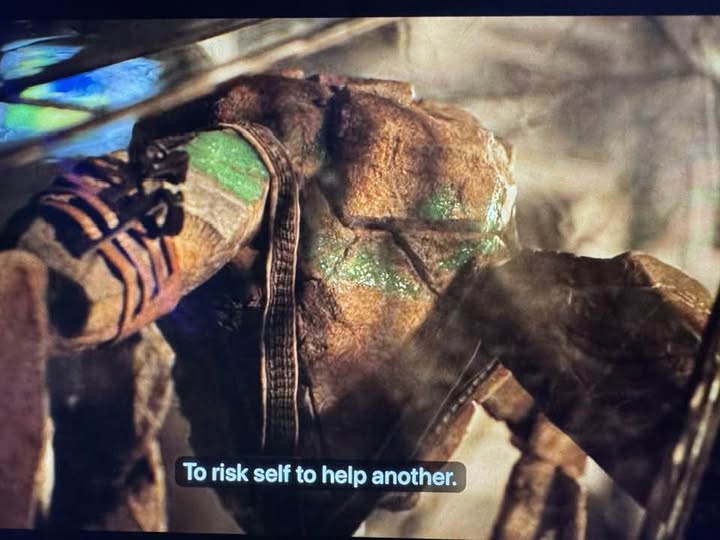
Since it’s myth we’ve been visited, and a pipe dream that we will be anytime soon, the imaginer gets to decide whether visitors will be malign or benign. The most powerful scene in “Project Hail Mary,” based on Andy Weir’s novel, is an astronaut from another solar system asking a human one for the English words for the golden rule. Weir and Spielberg both propose that sentience and evolution, wherever they occur in the infinite vision of the Creator, always produce creatures who, at their best, conduct themselves with decency, in the spirit of self-sacrifice for the sake of others. Too bad we have to imagine space aliens coming all that way just to lead a Bible study on Matthew 7:12.
(Image: From “Project Hail Mary,” ammonia-breathing Rocky asking NASA’s Grace for the good news)